

It’s normal for your car’s engine to get hot when it’s running—as long as it stays within its normal operating temperature. However, excessive heat can cause serious damage to the engine or its components, which is why vehicles have dedicated systems to keep engine temperatures at an optimal level.
Your vehicle is also equipped with certain components to help keep the engine’s temperature in check, such as the coolant temperature sensor Most vehicular platforms have a coolant temperature sensor for the engine control module (ECM) called the engine control temperature (ECT) sensor, as well as a sensor for the coolant temperature gauge. In this article, we’ll discuss the former—the ECT sensor that reports to the ECM.

What are the Signs of a Bad Coolant Temperature Sensor?
If you suspect that your car has a bad coolant sensor, we’ve listed some common indicators that this component is indeed faulty to help you confirm your diagnosis. Keep in mind that we’ll mostly be talking about skewed ECT sensors that are reading in range, but reporting a temperature that doesn’t reflect the actual engine temperature.
Illuminated Check Engine Light (With Specific System Codes)
A wide array of engine issues could set off your check engine light. If you own a scan tool, some of the codes that point to a faulty coolant temperature sensor are P0115 through P0119. These diagnostic trouble codes (DTC) often signify problems with the sensor or its circuit.
The ECM—or the powertrain control module (PCM)—will only catch an ECT that is out of range (too high or too low). It won’t catch an in-range failure of the ECT sensor. This means you can have a skewed ECT sensor and have no codes stored.

If the ECT has completely failed (shorted or open), the PCM will typically substitute a value of 101°F and will run the cooling fan all the time.
Scanning the “Generic” datastream will show -40°F with an open ECT circuit or disconnected sensor, or something like 260°F if the ECT or its circuit is shorted. Meanwhile, scanning the OEM “Enhanced” datastream will show the substituted value the ECM will use.
Engine Stalling, Hesitation, or Misfiring
This sensor also tells the engine’s computer how much fuel is necessary based on the engine coolant or cylinder head temperature (depending on the engine). If it becomes skewed rather than failing outright, meaning it starts sending wrong information to the PCM/ECM, it can cause hard starting, stalling, fast idle, inoperative A/C, fuel trim codes, and may cause stalling or hesitation.
Overheating
One of the more severe symptoms of a bad coolant sensor is an overheating engine. However, this will only happen if the sensor reading is skewed to the point that the engine cooling fan never engages, which typically causes overheating problems in traffic or at a drive-thru.
If the sensor is open or shorted, the fan will run all the time to prevent overheating.
This kind of ECT failure can happen but isn’t common. As mentioned, a skewed reading that is within the voltage range expected by the PCM (0.4-4.6 volts) won’t set a trouble code for the sensor but may cause other codes to be set.
Excessive Emissions
Another sign of a skewed in-range failure of the ECT is increased vehicle emissions. If the ECT sensor is erroneously reporting a colder engine temperature, and the fuel trims (the adjustments used by the PCM to keep the air-fuel mix balanced) reach their maximum limit, it can cause the air-fuel ratio to run excessively rich—which means too much fuel.

As such, the extra fuel may cause the atalytic converter to overheat. However, this is extremely rare and even with the ECT readings skewed, the PCM can prevent catalyst damage using its fuel trim algorithms.
If the Intake Air Temperature (IAT) is reporting a temperature that is 101°F (truthfully, on a hot day) and the ECT is reporting 45°F as if it were a cold day (when it’s not), the PCM/ECM will over-fuel during first start and wet the spark plugs due to over-fueling. This varies with platform algorithms, but the principles remain the same.
Inefficient Fuel Consumption
Your engine uses the coolant temperature sensor readings to determine if the vehicle is warm enough. If this sensor is sending inaccurate information to the engine control unit (ECU), the engine could use up more fuel than necessary. But again, this is more of a possibility with a skewed sensor, but less likely to happen with an open or shorted sensor due to the PCM algorithms.
What Causes a Coolant Temperature Sensor to Go Bad?
When a vehicle’s coolant temperature sensor fails or goes bad, it’s typically due to the following reasons:
- It might not work properly due to electrical problems caused by a poor connection, whether in the sensor itself, the wiring harness, or other connecting parts.
- The part is corroded by moisture. Minor corrosion can be resolved by cleaning the part, but replacement is necessary if the damage is severe.
- It might leak coolant from the sensor base up through the terminals and even shove coolant into the wiring. This is rare, but it can and has happened.
Keep in mind that other system codes and symptoms could also appear for cooling system problems, coolant leaks, and thermostat issues. It could be an easy fix if detected and addressed early.

What Does a Coolant Temperature Sensor Do?
To fully understand what it does, it can be important to know what it is and how it works.
What is an Engine Coolant Temperature Sensor?
In a nutshell, the engine coolant temperature (ECT) sensor is a negative temperature coefficient thermistor encased in brass. It is submerged in the vehicle’s coolant at a place where it’s most likely to read an accurate average temperature of the engine’s entire coolant supply.
How Does a Coolant Sensor Work?
The PCM has an internal 5-volt reference voltage system that supplies power to various sensors, including thermistors (like the ECT, IAT, and transmission oil temperature sensors or TOT) and potentiometers. However, thermistors typically receive only 4.6 volts instead of the full 5 volts. This is because the PCM/ECM includes a dropping resistor on the signal wires connected to these sensors, which reduces the voltage before it reaches them.
But to increase the resolution of the ECT signal on many (but not all) platforms, there are two dropping resistors and a transistor in the PCM/ECM (see diagrams below).
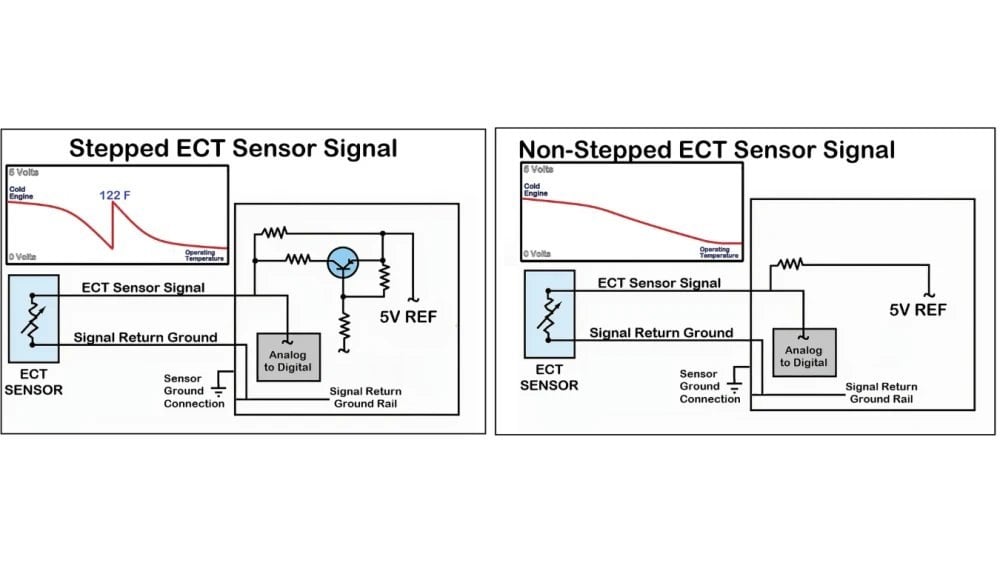
Many modern engines have two of these sensors. One will measure the temperature of the coolant and the other will measure the temperature of the cylinder head itself, which is the hottest part of the engine during operation. On some platforms, the cylinder head temperature (CHT) is used to activate protective algorithms designed to prevent engine damage from overheating whenever possible.
Where is the Engine Coolant Sensor Located?
The location of the coolant temperature sensor can vary, but it is often found where the coolant’s temperature is at its highest: in the engine block or on the cylinder head. There can also be ECT sensors in other areas of the vehicle to monitor the temperature in multiple areas.
If there are numerous coolant temperature sensor locations, they could depend on the car’s make and model.
Coolant Temperature Sensor Replacement Cost
Like other components, the total cost to replace a coolant temperature sensor could depend on various factors, including the replacement part’s price and labor fees.
A replacement ECT sensor can go for anywhere from $2 to over $300. The price varies significantly depending on factors such as the materials it’s made of, your car’s make and model, and more. Meanwhile, labor costs to replace this sensor often range from $100 to $125. Getting a professional to replace it can be ideal, but it is possible to do it yourself. Just keep in mind that this sensor is delicate and requires precision when handling.
FAQ
Why is my coolant temperature sensor reading high?
It can happen because of a bad coolant temperature sensor, but that is not always the case. Sometimes, this problem can stem from thermostat malfunction, coolant leaks, and water pump damage. A thorough diagnosis could be essential to pinpoint the real cause of the high reading.
Can a bad coolant temp sensor cause overheating?
Yes, as previously mentioned, a bad coolant temperature sensor can cause a vehicle to overheat on rare occasions. This can happen when the engine cooling fan does not engage due to incorrect information or skewed readings from the ECT sensor.
Does the coolant temperature sensor affect AC function?
A faulty coolant temperature sensor can impact your AC’s function indirectly. If the readings are inaccurately high, the ECU may foresee or treat it as overheating and shut down the AC. However, there could be other more likely causes based on what type of AC malfunction occurred and what happened leading up to it.