
The Short Version: Fan belt is a bit of a dated term these days, but there are still a wide assortment of belts performing important tasks under the hood of any internal combustion car. We go over what they do, why they’re designed the way they are, as well as what the differences are between a normal accessory belt and a timing belt. Finally, we recommend some top brands and tell you exactly how to find the right one for your car.
Do a search for “fan belt” and you’ll actually find an assortment of belts that do a variety of important jobs under the hood of any vehicle. They’re driven by the crankshaft – the main power highway for all internal combustion engines – and their jobs include spinning the fan, alternator, A/C condenser, power steering pump, and more.
But fan belt is actually a dated term. Cooling fans on most modern vehicles are driven by electric motors instead of actual belts, but the term fan belt is still sometimes used as a blanket term. Well, OK, if we’re being pedantic, some cars have both electric and crankshaft-driven fans, like the B5-generation Audi S4 sports sedan and wagon. The correct term is accessory belt, because it spins the various accessories bolted up to the engine.
This guide discusses the history of automotive belts, as well as exactly what the differences are between the various kinds found in today’s engines. Knowing exactly which kind you need and how it functions will help you become a more informed and prepared DIY wrencher.
Types Of Accessory Belt
Accessory “V” Belts
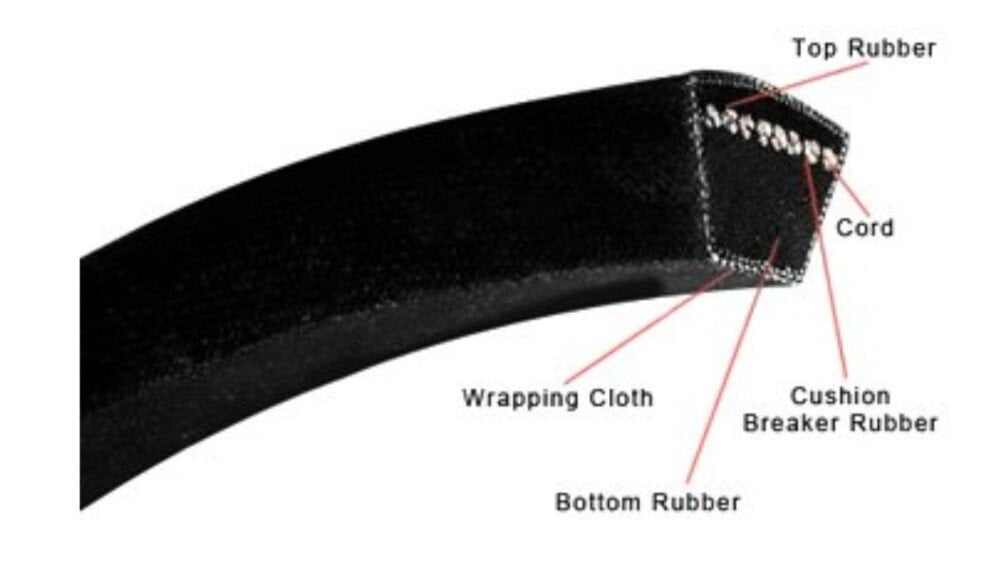
One type of engine accessory belt is known as the “V-belt” because its trapezoidal shape tapers from wide to narrow as it forms a V point near the bottom – which is smooth on the other side. Tension on individual accessory belts is adjusted manually by tightening an adjuster to change the position of an idler pulley wheel, or by loosening and tightening slotted mounting brackets that move accessories – such as an alternator – by fractions of an inch.
As vehicle manufacturers have added more accessories over time, their initial solution was adding more drive belts to power them. So cars went from one belt driving the fan, water pump, and alternator to two or three separate belts now also driving the power steering pump, A/C compressor, and emissions air pump.
The V-belt is one of the most effective solutions because of its strength, relative quietness, power transfer, and durability. The belt’s ability to provide a small degree of slippage when needed makes it a good match for accessories that shut on and off by the use of a clutch, such as air conditioner compressors and older-style radiator cooling fans.
Multi-Grooved Or Ribbed “V” Belts
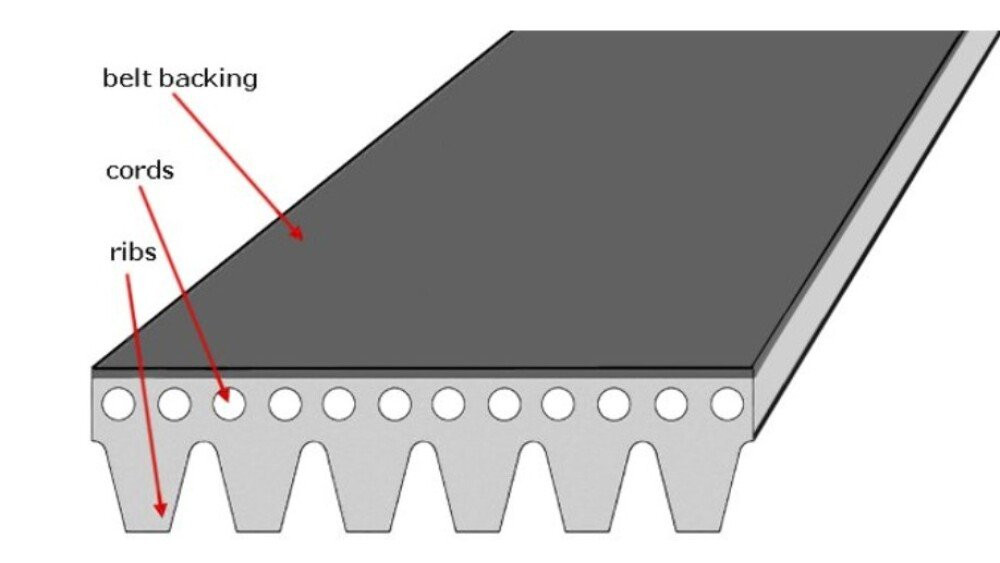
A variation of the V-belt is what’s called the multi-grooved or ribbed belt. It possesses multiple “V” shapes placed side-by-side. Its underside surface features endless parallel ridges designed to slot into mating grooves on its corresponding pulley to prevent slippage. (Here I mean the bad kind of slippage that’ll knock it out of its routing.)
While this version of the V-belt is typically wider, it’s also thinner and more flexible, and it builds up less heat as it spins along. As load increases under higher engine speeds, this belt’s rubber grooves wedge themselves deeper into the pulley, and increased friction provides the necessary grip to run as efficiently as possible.
Serpentine Belts
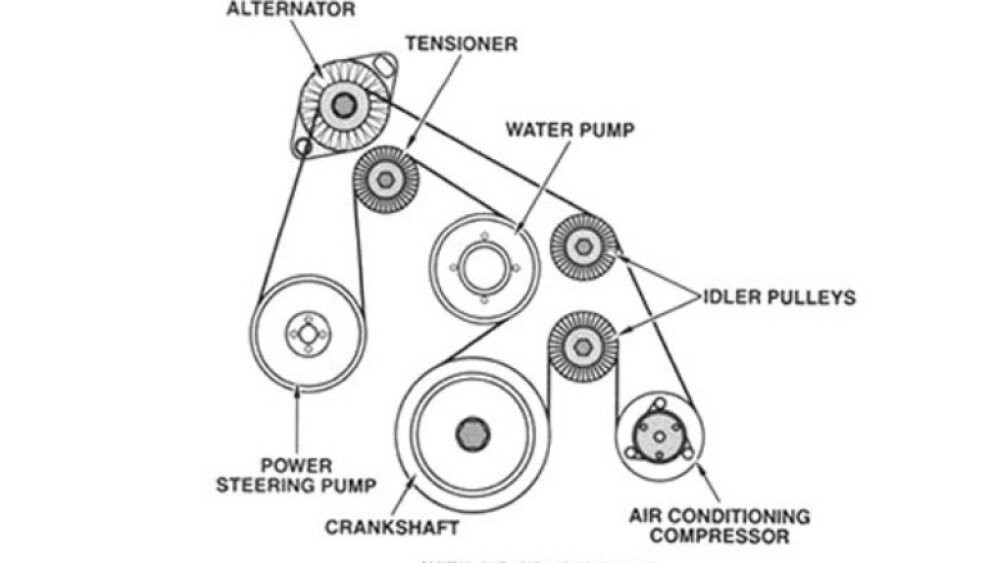
A serpentine accessory belt is simply a longer, endless belt constructed in the same fashion as a single accessory belt. A single serpentine belt typically powers all externally mounted accessories. Idler pulleys maintain its proper routing and help maintain tension. But unlike individual belts, the tension on a serpentine belt is mainly provided by a single tensioner pulley that’s under constant spring pressure.
Given the high quality of modern serpentine belts, they typically last 60,000 to 100,000 miles, so they’re generally not considered a regular maintenance item.
Serpentine Belt Tensioners
This type of drive belt tensioner never needs adjustment. The unit will release its tension when force is placed against it using proper hand tools if the belt needs to be removed or replaced.
Why Do Modern Cars Use Serpentine Belts?
Several factors have changed the way automotive engineers have designed accessory drive belts. An increased demand for accessory space plays a big role. At the same time, as engine compartments have gotten smaller, they’ve become more crowded. Packaging of mechanical components into constricted spaces is a critical part of overall vehicle design.
Timing Belts
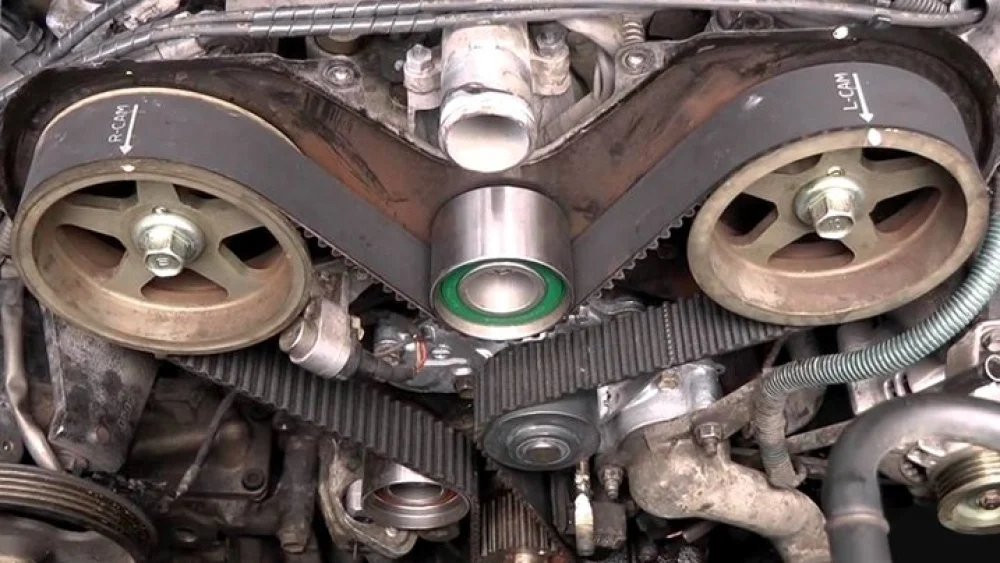
Are A Drive Belt And A Timing Belt The Same?
No. Although both of them perform some form of drive function, timing belts should not be confused with accessory belts.
Unlike drive belts that run accessories mounted on the outside of the engine, timing belts play a more crucial role: facilitating the timing between the pistons, intake valves, and exhaust valves.
Timing belts feature flatter construction with molded teeth that mate up with the teeth on the crankshaft and camshaft drive gears. They’re also typically very stiff and strong – after all, this is a very important task, and if one fails, it could cause catastrophic engine damage.
A spring-loaded or hydraulically actuated pulley provides constant tension to ensure that this belt is as slip-proof as possible.
Replacing Timing Belts
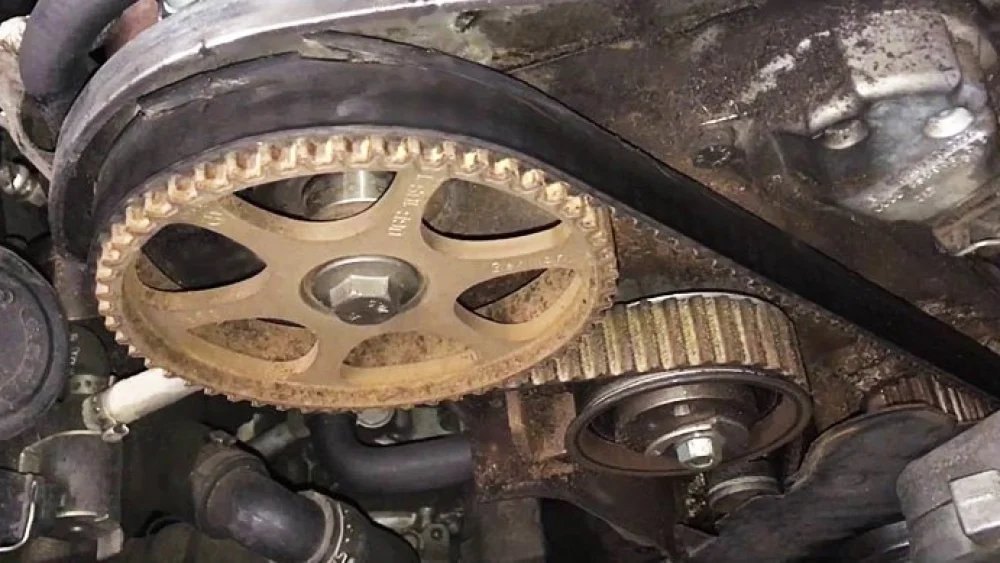
Because of its crucial role in engine operation, all timing belts have a fixed replacement interval that’s determined by the manufacturer, whereas accessory belts are checked for wear and replaced either when necessary or at a longer interval.
When it comes to a timing belt’s replacement cost, it’s normally higher than replacing any accessory belt because it’s usually a more time-consuming job that requires removing more parts. When timing belt replacement is performed, you also have to replace a spring-loaded pulley or tensioner and related hardware; the exact list depends on your engine model. If the timing belt is also used to drive the water pump, automakers recommend replacing the pump as well.
CARiD carries numerous kits containing all these parts, from leading brands. For instance, the Aisin Timing Belt Kit is one of our most popular options.
Purchasing Replacement Accessory Belts From CARiD
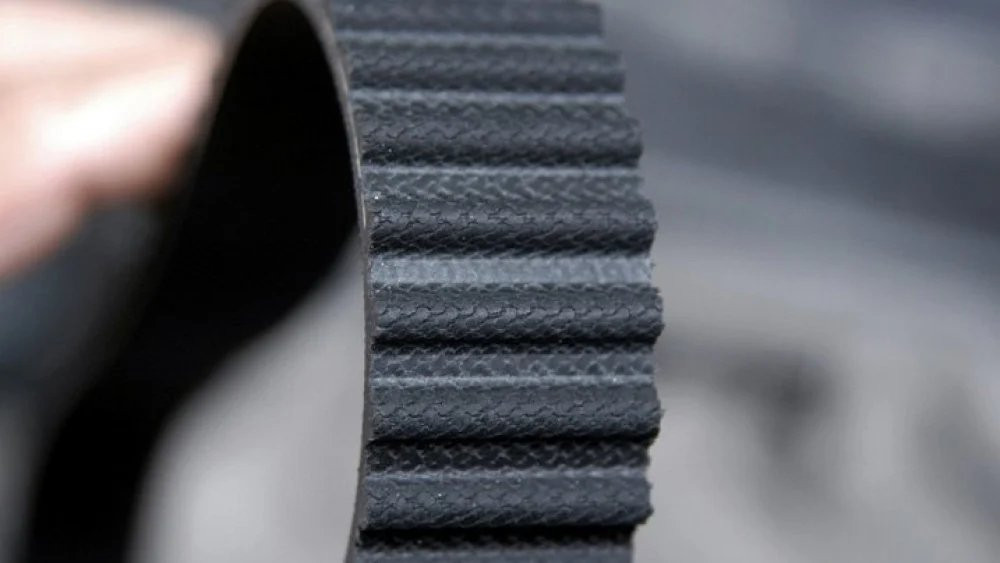
When purchasing replacement belts, it is important to know your vehicle’s year, make, and model, engine size, and in some cases, whether it is equipped with certain accessories such as air conditioning.
Some of the top brands offering quality drive belts are ACDelco, Dayco, Continental, Bando, and Gates. In order to improve their products, all of them implement the latest engineering solutions and achievements of the chemical industry, such as high-quality EPDM rubber, aramid fibers, or specially designed cords.
Bando Belts
In particular, Bando is part of the Japanese corporation Bando Chemical Industries which has a great experience in rubber product manufacturing. The Bando Rib Ace series features a proprietary EPDM compound, oil- and heat-resistant backing, bidirectional cord to eliminate tracking, and other solutions aimed at a longer lifespan, quieter operation, better grip, resistance to stretching, and so on. The Bando Rib Ace V-Ribbed Serpentine Belt is one of the most popular products used in lots of modern vehicles by Kia, Hyundai, and Audi. Another widespread model of the Bando Rib Ace V-Ribbed Serpentine Belt can be found in many Japanese and Korean cars.
ACDelco Belts
ACDelco needs little introduction as it’s a big supplier of OEM or aftermarket parts for pretty much any General Motors vehicle. The ACDelco GM Original Equipment V-Ribbed Serpentine Belt is popular with the owners of Chevys, Cadillacs, GMCs, and Hummers. Another leader in the OEM equipment market is Dayco. Its Poly Rib Serpentine Belt features a highly effective aramid reinforced EPDM compound ensuring high durability and perfect resistance to cracking, heat, and stretching. It perfectly fits a wide range of Japanese and Korean vehicles.
Gates Belts
Gates is another serious player in the rubber industry whose products set a high benchmark in terms of quality, efficiency, and longevity. Its assortment of belts is huge and covers virtually any vehicle that has at least one drive or timing belt. Particularly, the Gates Micro-V V-Ribbed Belt suits many Dodges, Jeeps, and some Japanese vehicles.
Continental Belts
Last but not least, don’t forget Continental: a German manufacturer whose belts are famous for their long, trouble-free operation. The Continental ContiTech Conti-V Multirib Serpentine Belt is a shining example, and they’re an OE supplier for many different vehicles across many segments and brands, not just ones from the land of beer and sausage.
CARiD has a Shop by Service Type tool that lets customers search for the type of work a vehicle needs and select the make, model, and year. The site shows exactly the parts needed for a job. When you’re shopping for a new accessory belt, you may need to upgrade various pulleys and tensioners as well - we’ve got what you need for a complete job.
The History and Science Behind Automotive Belts
It’s interesting to dig into why belts are located where they are under the hood. In order to pull cooling air through a vehicle’s radiator, a cooling fan needs to be located at the front of the vehicle just behind the radiator. Traditional, older rear-wheel drive vehicles with longitudinally mounted engines have crankshaft pulleys right there at the front of the car, which are convenient sources of power for cooling fans.
Since the fan belt tends to be the biggest and most noticeable one on the vehicle, the expression became universal for all other belts that looked similar – no matter what function they performed. Many original engine layouts also used that fan belt to spin the water pump and alternator pulley, too, so it’s common to hear “water pump belt” or “alternator belt” get tossed around as blanket terms, too. Fun fact: Water pumps are still sometimes driven by a belt, but on many modern cars, they’re driven by electric motors.
However, as vehicles with front-wheel drive and sideways-mounted (known as transverse) engines grew in popularity, the front of the engine was no longer at the front of the vehicle where the cooling fan was.
Over time, engineers have perfected electric fan motors, temperature sensors, and the computers that they talk to, so belt-driven fans became less necessary. Because cooling fans don’t always need to be running at steady cruising speeds, electric motors that can turn on and off when needed proved to be more energy-efficient than constantly spinning drive belts.
But they’re still needed for spinning accessories, which is why accessory belt is a better general term. And since accessory belts are subject to constant rotation, load, and heat, they are constructed in a similar fashion as tires. An outer layer of rubber surrounds internal steel and cord reinforcements to minimize stretch and maximize strength when grip is needed under load.
FAQ
How much does it cost to replace an accessory drive belt?
Typically, the cost of the belt ranges from $5 to $50, and labor could vary between one to three hours depending on the complexity of the engine.
How long do accessory belts last?
Anywhere from 50,000 to 100,000 miles, depending on the type of belt and general operating conditions. Because of the variability, it’s important to inspect belts regularly for cracking and damage.
What happens when an accessory belt breaks?
Its corresponding accessory will cease functioning: You may lose power steering, or the water pump may no longer spin, which is a very dangerous scenario as it could lead to catastrophic engine damage.
What are the symptoms of a bad accessory belt?
Squeaking and squealing are top signs, and it’s always a good idea to replace idler pulleys and tensioners when replacing them.