
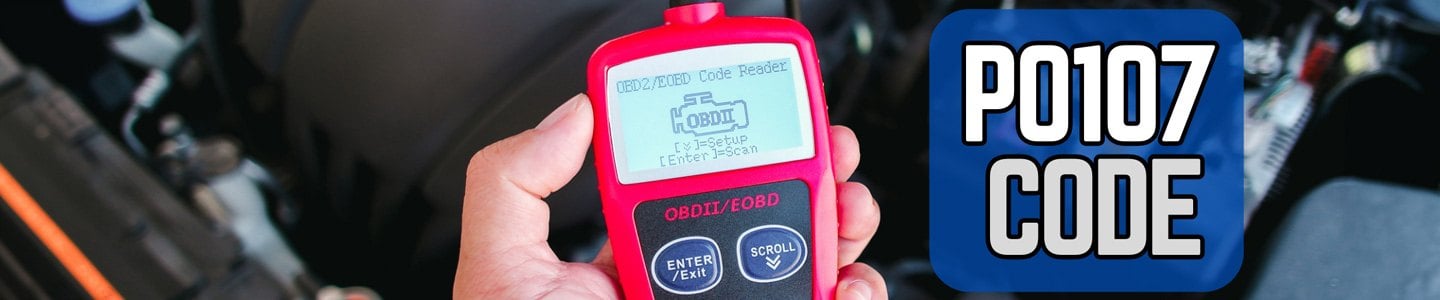
The manifold absolute pressure (MAP) sensor measures barometric pressure when you start the engine. It also measures manifold pressure and vacuum while the engine is running. This is an essential part of the powertrain control module (PCM)/engine control module’s (ECM) fuel and ignition timing control strategies.
When there is a problem with the MAP sensor, the diagnostic trouble code (DTC) P0107 may be set. Let’s explore this specific code and learn more about how it affects your car’s function and performance.
What Does Code P0107 Mean?
The P0107 engine code stands for “Manifold Absolute Pressure/Barometric Pressure Circuit Low.” Your vehicle’s main computer, the PCM, stores this code when it detects a problem with the MAP sensor or the sensor circuit. Fixing the P0107 code as soon as possible is crucial because if left unaddressed, it can lead to drivability and safety issues.
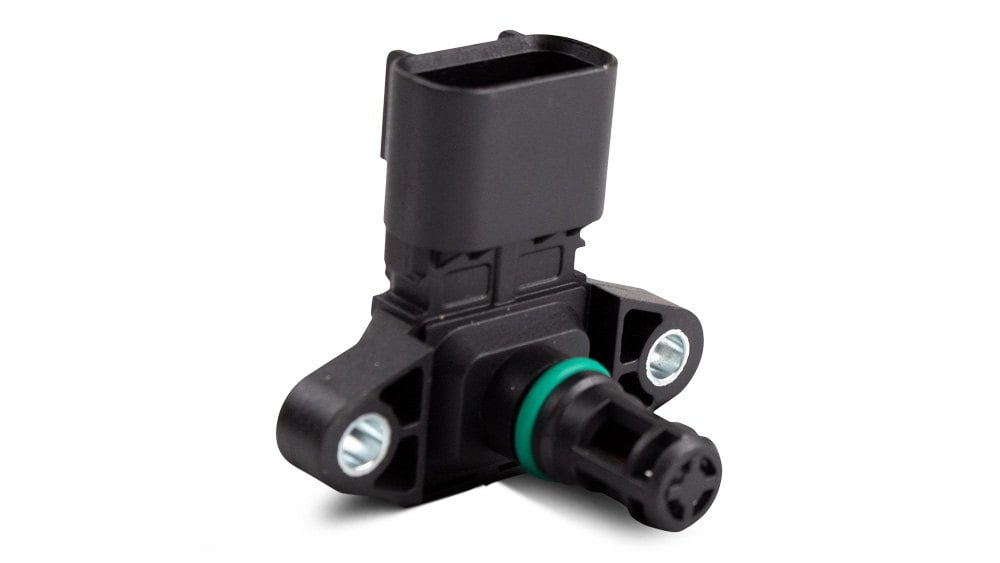
The MAP sensor measures the air pressure within the intake manifold. Meanwhile, the barometric pressure (BARO) sensor measures the air pressure outside the vehicle.
In almost all modern vehicles, the BARO sensor is integrated into the MAP sensor or mass air flow (MAF) sensor. The PCM uses the data from these sensors to calculate the proper air-fuel ratio, ignition spark timing, and other functions of the emissions control systems.
As soon as the key is switched to the ON position, the ECM/PCM starts recording the barometric pressure, an input from the MAP sensor. When the engine is running, the MAP sensor input is used to calculate engine load. It may also be used as a backup signal on engines with MAF sensors, in case the MAF sensor fails.
For example, if the PCM/ECM sees a high altitude BARO reading when the engine is nearer sea level, it will deliver slightly less fuel and advance the ignition timing.
This can happen if the MAP/BARO sensor is only slightly skewed (in range, but incorrect) and causes the PCM/ECM to set lean codes rather than the P0107, which indicates an out-of-range reading. In short, the MAP sensor can cause problems without setting a MAP sensor code.
How is code P0107 triggered?
The setting conditions for the P0107 may differ depending on the vehicle manufacturer, but the PCM generally sets the code when the voltage from the MAP sensor stays below 0.5 volts for 10 seconds or more while the values for throttle position, engine revolutions per minute (RPM), and oxygen sensors change.

The P0107 is a generic powertrain code, which means that it applies to vehicles equipped with onboard diagnostics (OBD-II) systems. For example, you may encounter the P0107 code on Chevy, Ford, Dodge, and Volkswagen vehicles. Note that exact code definitions may differ across different vehicle manufacturers.
Let’s look at a couple of different OEM P0107 strategies:
Mitsubishi’s criteria for setting a P0107:
- Eight minutes or more have passed since the engine starting sequence was completed when the engine coolant temperature at engine start is 0°C (32 °F) or lower.
- Volumetric efficiency is higher than 20 percent.
The criterion to set P0107: Manifold absolute pressure is 5 kPa (1.5 in.Hg) or lower for 2 seconds.
Dodge’s criteria for setting a P0107:
- The ignition on and battery voltage is greater than 10.4 volts.
- The PCM detects that the MAP sensor input voltage is below the minimum acceptable value.
A lower input voltage indicates a higher-than-normal pressure reading—specifically a reading that isn’t realistically possible with the engine running.
What Causes Code P0107?
Several issues can cause the P0107 code. Let’s take a look at each one:
- Faulty MAP/BARO sensor
- Circuit issues
- Insufficient engine vacuum
- PCM problems
Faulty MAP/BARO Sensor
A defective MAP/BARO sensor is one of the most common causes of the P0107 code. These sensors can malfunction due to buildup in the sensing element or damage to the sensor itself.
Circuit Issues
Damaged wires, corroded terminals, and poor MAP or BARO sensor connections can cause the P0107 to be set. Open or short circuits in the MAP/BARO sensors’ signal, reference, or ground circuits can also trigger the code.

Insufficient Engine Vacuum
Insufficient engine vacuum caused by leaks in the MAP sensor hoses or nearby seals can affect the sensor reading and cause the P0107 code to be stored. However, almost all MAP sensors today are already mounted directly outside the intake manifold and sealed with an O-ring, eliminating the need for a hose connection. Hose and seal leaks apply to older MAP sensors.
That said, if the engine vacuum is actually low (and not just because of hose leaks), your problem and symptoms will be far greater than just a P0107 code.
PCM Problems
If your PCM/ECM needs an update, it may trigger the P0107 code. If your PCM is damaged or has internal circuit failures related to this input, it may trigger the code, but the PCM is the LEAST likely cause of this code. So, don’t rush to buy a PCM or have it reprogrammed.
What Are the Symptoms of Code P0107?
If you’re dealing with the P0107 code, your vehicle may exhibit one or more of the following common symptoms.:
- Check engine light on
- Rough running/black smoke
- Poor fuel economy
- Stalling and surging
Check Engine Light On
An illuminated check engine or malfunction indicator lamp (MIL) is often one of the first signs of a stored trouble code, like the P0107. In some cases, it may be the only noticeable sign. If your vehicle’s check engine light is on, use an OBD-II scan tool to investigate the issue further.
Rough Running
The MAP sensor’s input is important to the PCM/ECM’s fuel and timing calculations. If it’s skewed or unreliable and the platform doesn’t have a MAF sensor, the MAP sensor’s failure may cause the engine to run rough or rich. It all depends on the OEM algorithms as to how severe the rough running will be.
Poor Fuel Economy
To make up for what the PCM detects as a low voltage reading from the MAP/BARO sensors, the engine burns more fuel to maintain the ideal air-fuel ratio. In this situation, we assume that the reading is out of range, triggering the P0107 code. If the MAP/BARO reading is only slightly skewed, which keeps it in the range but is inaccurate, you may have lean or rich codes depending on which way it’s skewed. But it will not set the code.
Stalling and Surging
Stalling and surging are common in instances where the engine’s air-fuel ratio is inconsistent. The engine struggles to run smoothly, causing the vehicle to suddenly stumble and surge.
If this stumble/rev-up happens while idle, that’s usually an indicator that the carbon canister is saturated because the driver has been packing the gas tank when they refuel.
How to Diagnose Code P0107
To fix trouble codes like the P0107, it’s important to thoroughly diagnose the issue first. Here are some diagnostic steps used to troubleshoot the P0107 code to give you an idea of how the process goes:
Do a Test Drive
Record the freeze frame data and duplicate those code setting conditions with a test drive. Closely monitor the engine load, throttle position, and engine speed on a data streaming scan tool. The MAP sensor voltage should change along with engine speed and load. Values may vary from 4V or more when the vehicle is accelerating to 1V or less when the vehicle is decelerating.
Perform a Thorough Visual Inspection
Check if the MAP or BARO sensor is in its proper location. Pay close attention to any loose connections to the sensor. Inspect the MAP sensor vacuum hose and any seals and gaskets nearby for leaks or other signs of damage. Lastly, make sure that the MAP/BARO sensor is securely connected to the intake manifold.
Check the MAP/BARO Sensor
With the key on and engine off, and with your OBD-II scanner, check the MAP sensor connector. There should be a steady 5V reference voltage and a good ground connection to the sensor.
Perform a Vacuum Pump Voltage Output Test
Also using a scan tool, you can perform a vacuum pump voltage output test of the MAP sensor. As you apply 18-20 inches of vacuum, the voltage should steadily decrease from 5V to less than 1V. Wiggle the sensor harness and connectors to make sure they’re not the source of the problem.

How to Fix Code P0107
To give you an idea of what kind of repairs are done to fix the P0107, here are some common solutions to the code based on the root cause:
Fix or Replace Damaged Wiring and Connections
If there are connection issues like an open short in the signal circuit wiring, those issues need to be addressed. Similarly, damaged wiring harnesses and connectors need to be fixed or replaced as well.
Fix Vacuum Leaks
Vacuum leaks can affect MAP/BARO sensor readings, so make sure to fix and address those, too. Use the appropriate replacement part and refer to a repair manual for more information.
Replace Faulty MAP/BARO Sensors
Replace your MAP/BARO sensors only if you’ve ruled out other possible causes. If you’re unfamiliar with intake manifold repairs, it’s best to have a professional do the job for you.
Update PCM Software
Although rare, PCM issues can cause the P0107 code to be stored. Check if there are technical service bulletins (TSBs) or other advisories from your vehicle manufacturer about PCM software updates. Have those updates installed by a certified technician.
Other Codes Related to P0107
The following are some of the codes that could appear due to the same underlying issue but with slightly different setting conditions.
P0105
This is another trouble code that warns of a potential problem with the MAP or BARO sensors or their circuits. It can be triggered by a disconnected MAP sensor vacuum hose, a malfunctioning MAP or BARO sensor, a faulty throttle position sensor, circuit issues, or vacuum leaks. Symptoms such as poor engine performance, engine misfires, or engine backfires are common with this code.
P0108
If the P0107 engine code indicates that the signal from the MAP or BARO sensor is low, the P0108 is triggered when the signal from these sensors is high or above the normal range. The P0108 code can be caused by a bad MAP/BARO sensor, faulty MAP/BARO sensor wiring or circuit issues, or a clogged catalytic converter. Symptoms of this code include poor engine performance and reduced fuel economy.
P0109
When a connection has an intermittent fault, it means that a circuit is malfunctioning at irregular intervals. The P0109 code is stored when the PCM has detected an intermittent reading from the MAP or BARO sensor circuits. This issue can be caused by malfunctioning MAP or BARO sensors and corroded, loose, or damaged wiring. If this code is stored, your vehicle can exhibit signs like hesitation, poor engine performance, and poor fuel economy.
FAQ
Is it okay to drive with a code P0107?
It is not advised to drive your vehicle if you have a P0107 warning because this code can cause poor engine performance and other drivability issues. We recommend having the issue fixed as soon as possible to prevent engine damage and to keep you and your passengers safe.
How much does it cost to replace a MAP sensor?
The cost of replacing MAP sensors can range anywhere from $10 to $700 for the parts alone. Labor costs and taxes will depend on your specific location.