TPMS Complete Kits
-
-
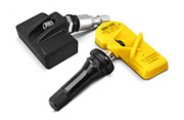
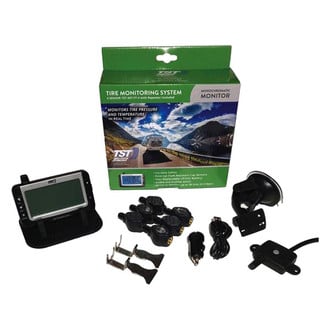
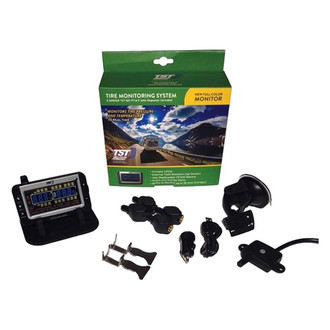 TST® - 507 Series Flow Thru Sensor TPMS System$348.75 - $478.81
 -
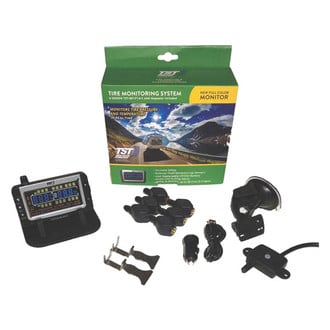
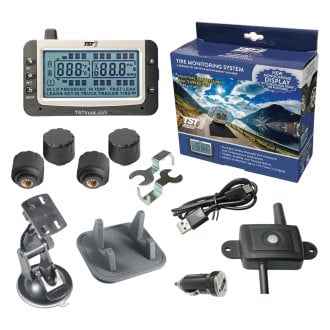 TST® - 507 Series RV Cap Sensor TPMS System$348.75 - $478.81
 -
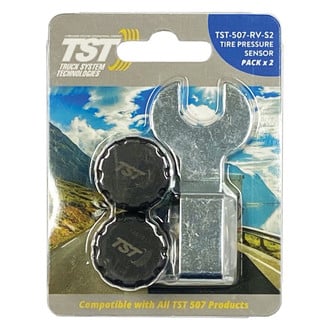
 TST® - 507 Series TPMS Cap Sensors$133.93 - $251.10
 -
-
-
-
-
-
-
-
-
-
-
-
-
-
-
-
-
-
-
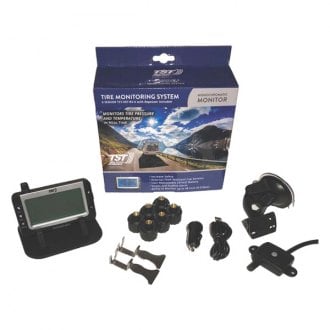
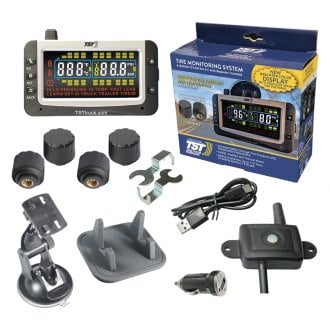
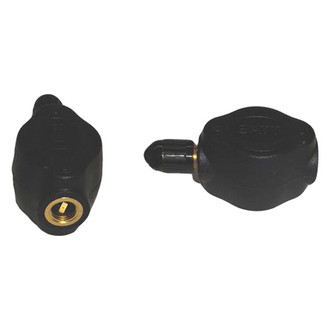

Tire manufacturers do constant research, development, and testing, often in coordination with car makers, to ensure their tires are constructed to provide the load capacity, traction, fuel economy, ride quality, durability, and overall performance expected by drivers. But regardless of how carefully a tire is made it won’t perform well, and could even fail suddenly, if it’s not properly inflated. No matter what kind of vehicle you have - car, truck, motorcycle, RV, or big rig, you can monitor your tire pressure and be alerted if there’s a problem with one of our Tire Pressure Monitoring Systems (TPMS).
In response to a number of accidents and fatalities attributed to underinflated tires, Congress passed the TREAD (Transportation Recall Enhancement, Accountability and Documentation) Act in 2000. Included in this act was a provision that all passenger cars and light trucks under 10,000 lbs. GVWR (Gross Vehicle Weight Rating) must be equipped with a TPMS as of September 1st, 2007. So, almost all 2008 model year and newer vehicles have TPMS systems. But what if you have an older car or truck, a motorcycle, or one that’s over 10,000 lbs. GVWR? You can enjoy the same level of safety with a TPMS from CARiD.
In addition to the above-mentioned applications, one of our systems can also be an improvement if your vehicle is equipped with an indirect monitoring TPMS system. The law mandated that a driver must be warned in the event of an underinflated tire, but some vehicle makers opted for a lower cost system that used the wheel speed sensors in the anti-lock braking system. The circumference of a tire, and the revolutions per mile it rotates, is reduced on an underinflated tire. The signal from that tire’s wheel speed sensor is compared by the computer to the rotational speed of the other tires and interpreted as a low tire, illuminating the TPMS warning light. However, an indirect system can’t indicate which tire is low or if all tires are uniformly low, nor can it display actual tire pressure.
All of the TPMS systems we offer are direct monitoring systems that indicate the air pressure in each individual tire, and many of our systems can also indicate tire temperature, a capability not found on many OE TPMS systems. Elevated tire temperature, which can be caused by something like a sticking brake unit, can result in a sudden blowout and loss of vehicle control. With our systems you can not only monitor pressure and temperature but set your own warning levels as well. OE systems only alert when pressure drops below 25% of recommended cold inflation pressure. And unlike most OE systems that only illuminate a dash warning light, many of our systems also feature audible warning capability. But these are only a few of our TPMS systems’ advantages. Our TPMS systems are also easy to setup.
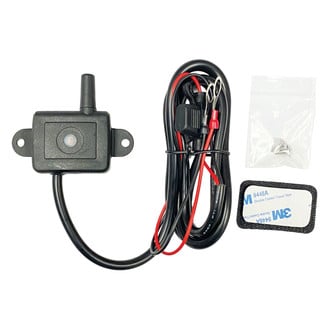
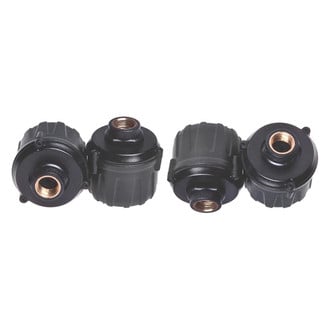
Although we offer systems with conventional wheel-mounted sensors if you prefer them, most of our TPMS systems use convenient, easy to install sensors that mount to your existing valve stems in place of the valve cap. No tire dismounting and remounting is required, and unlike OE sensors, many have easily replaceable batteries. And we have systems with monitors that are powered by rechargeable batteries, monitors that plug into your cigarette lighter or 12V accessory socket, and even monitors that are solar powered, so no complicated wiring is needed. We have systems that are specially designed for particular applications, including semi-trucks and trailers. Because of the great distance between the sensors and monitor, some of these systems come with signal boosters to ensure reliable operation.