
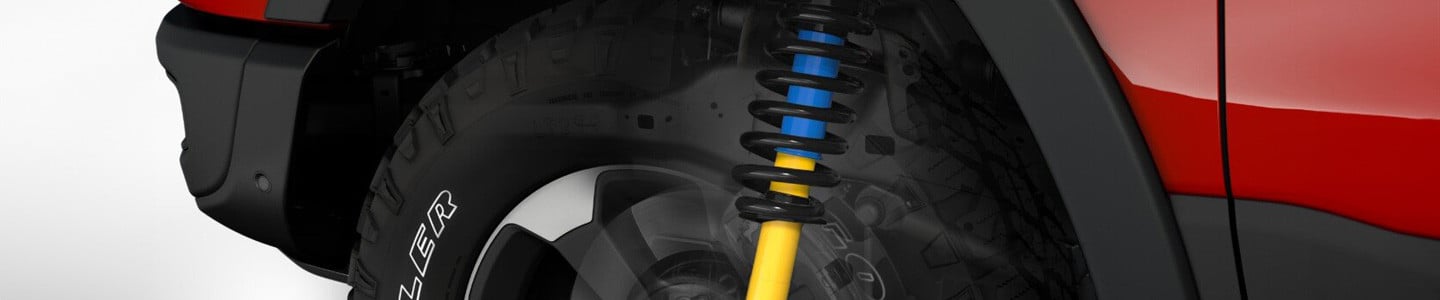
The Short Version: Shock absorbers and struts (also known as dampers) help improve ride comfort and performance, and when they fail, the symptoms can be quite jarring – literally. Luckily, diagnosing a failed shock absorber is easy, as it typically begins to go out gradually. Replacing it is also relatively simple for even a novice mechanic. This guide will help discuss how shock absorbers work, the symptoms of a bad shock absorber, and when to replace shocks and struts.
When a car or truck hits a bump, that vertical energy goes into the springs, and they counteract the force by rebounding downward. But since the vehicle rarely hits bumps evenly on all four corners, each spring responds at a different rate. Shock absorbers are crucial suspension components that dampen the up-and-down movement of a car or truck’s springs. If these control devices weren’t part of the suspension system, the car or truck would continue to hop up and down until the kinetic energy in the springs finally dissipated, resulting in a ride that’s bouncy and hard to control.
To dampen that unwanted spring motion, shocks contain hydraulic fluid that flows through a series of valves and channels. The natural resistance and drag caused by that fluid causes the shock absorber to move up (bound) or down (rebound) more slowly than the spring would – calming the bouncing. That steady ride improves vehicle comfort and helps ensure that all four tires are as firmly planted on the road surface as possible.
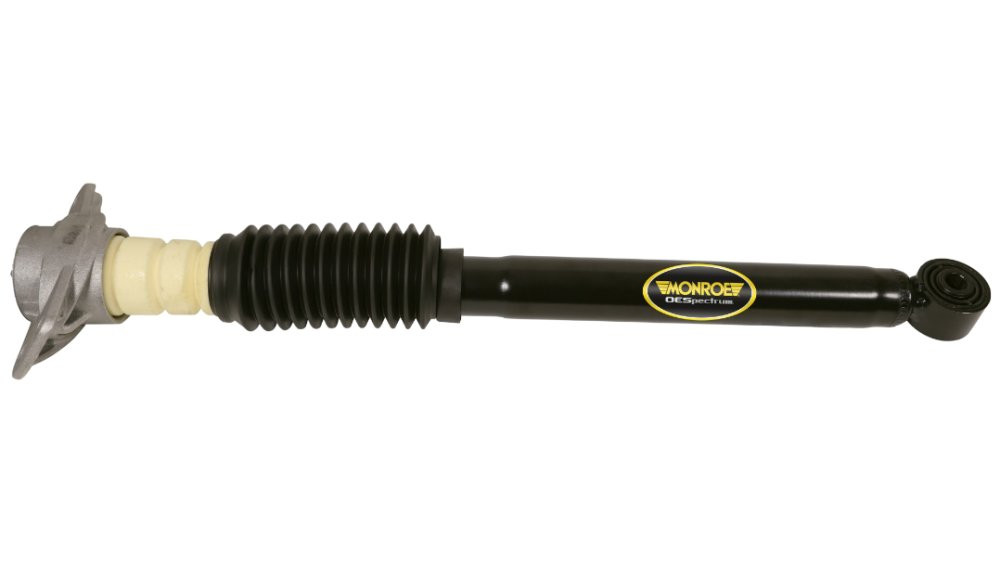
Are There Different Types Of Shocks?
Not every vehicle uses the same kind of damper. A shock absorber is a separate, standalone item in the suspension that carries very little or no weight – that’s the spring’s job. As its name suggests, a shock absorber’s primary purpose is to absorb the energy of the springs. It is typically mounted on the vehicle’s axle, with the other end securely fastened to the body, but again, a shock absorber carries barely any vehicle weight.
A strut assembly is more all-encompassing, with a damper, spring, and sturdy frame that supports vehicle weight. The spring is mounted toward the top of the strut assembly, near the body mount. The damper, mounted in the center of the assembly, moves vertically to control those aforementioned body motions. As with shock absorbers, it’s possible to replace just the damper if that’s all your vehicle needs, as the spring can be removed from the strut assembly.
Coil-over-damper suspensions, known more simply as coilovers, look similar to struts in that the coil spring surrounds the shock absorber. However, coilovers are typically sold as a unit, with the spring, damper, and frame already assembled. Coilovers typically offer the owner more adjustment over ride height, bound, and rebound, making them ideal for performance cars.
For simplicity’s sake, we’ll refer to the dampers that appear in all of the above suspension types as shocks or shock absorbers.

How Often Should I Change My Shocks?
Most manufacturers of shock absorbers advise replacing them at 50,000 miles, but that’s probably more for their benefit than the driver. While shocks from decades ago may have been spent at that point, improvements in design and construction allow today’s shocks to go much further under normal driving. In fact, it’s not uncommon for shocks to last twice that mileage over smooth pavement.
The biggest factor that determines shock life is where and how you drive. Spending significant time on poorly maintained or unpaved roads will shorten the lifespan of shocks considerably, as the heat they generate will begin to break down the hydraulic fluid or gas inside. Another factor can sometimes be the quality of the original equipment shock, as the hydraulic fluid inside can start to leak if the housing breaks down.
How Do Worn Shock Absorbers Feel While Driving?
Most shocks deteriorate internally over time without any visual outward signs, so it’s sometimes difficult to notice because the effects build up so gradually.
Shocks primarily lose their ability to control weight transfer as they wear. Signs of worn-out front shocks may include the car diving low on hard braking, which means more weight is riding up front than in the rear, reducing braking stability and increasing braking distance. Bad rear shocks can cause a vehicle to squat more when accelerating from a stop, reducing steering stability and, in some cases, acceleration.
Steering precision and overall stability will also be affected. If your starts vehicle swaying or leaning excessively around curves, these are signs that the shocks are having a hard time controlling weight transfer. Mild crosswinds may causing the vehicle to veer more off course, and those bumpy, hobbling motions will be even more pronounced when rounding curves on uneven road surfaces.
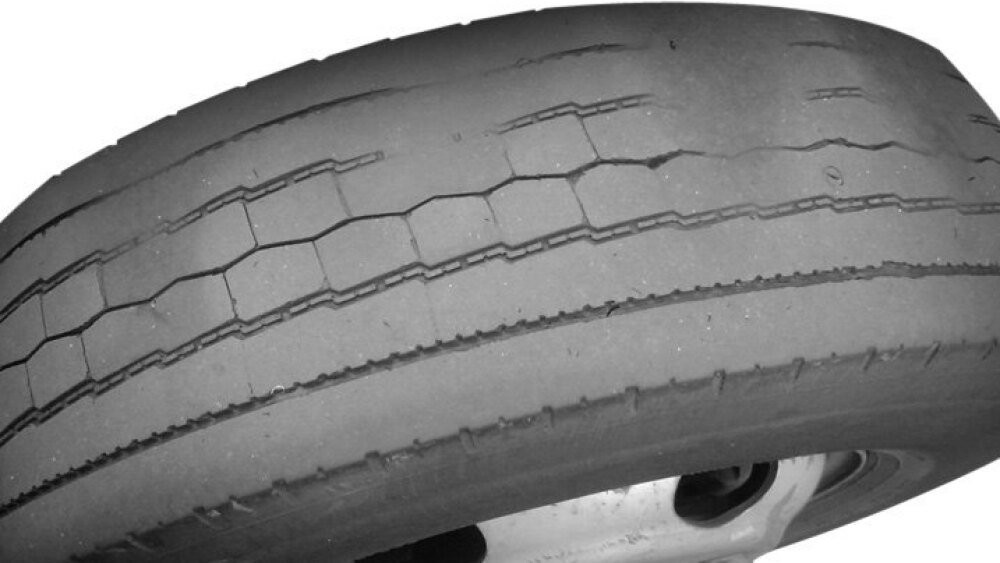
Tires can also provide some clues that shocks have failed. Check tires for signs of cupping, referring to evenly spaced areas of concentrated wear on the tread. These low spots occur because the tire is more likely to hop up and down, bouncing off the surface of the road after a bump instead of remaining flat.
Worn out shocks that no longer compress as smoothly will result in a hard, jarring ride over road imperfections, big and small. If the vehicle bottoms out easily as if there’s no resistance left, the shocks have given up the ghost a while ago.
A classic way to test for badly worn shocks is to push down on each corner of a parked vehicle. Shocks and struts in good working condition will just push the corner of the vehicle back up with little to no bounce. If they’re bad, the corner will easily bounce up and down with little resistance and continue bouncing for a few moments after you let go.
How Do I Inspect My Shocks?
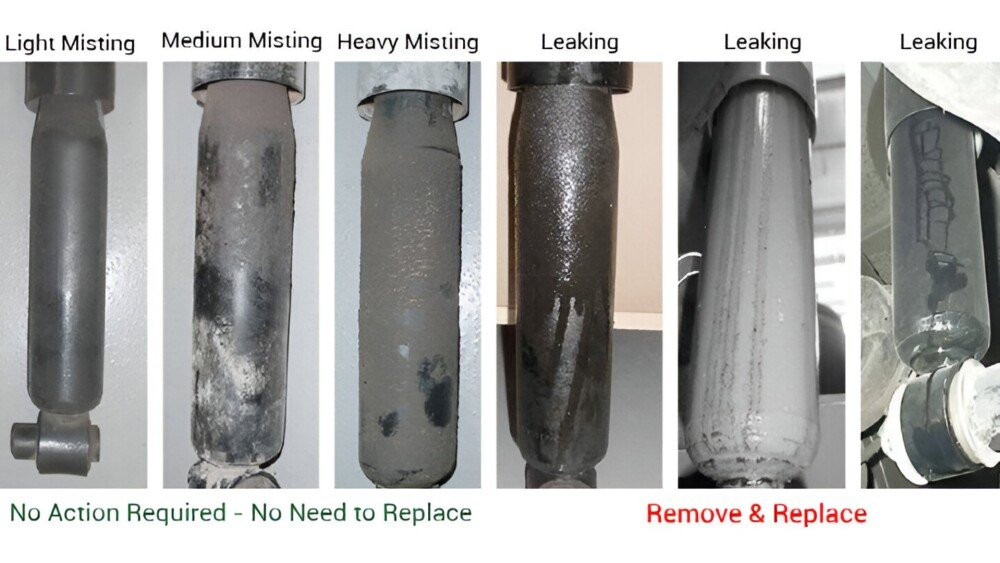
If there are too many questionable symptoms from the shocks, it’s time to take things a step further and climb under for a physical inspection. A sign that shocks are reaching the end of their useful lifespan is the seals within the housing wear to the point that fluid or gas leaks out. Some oil or fluid at the top of the shock is not cause for alarm, but a heavier film of wet oil on the outside of the housing is. Dirt and grease will stick to the fluid, making leakage easy to spot.
Dents in the shock housing are another sign that all is not well. Most often, dents occur from rocks or other debris striking the shock, a problem that’s more common on unpaved roads. If damage is significant, it can block the flow of hydraulic fluid.
In a simple shock absorber suspension, each end of the shock has a round eyehole to attach it to both a suspension control arm and the vehicle frame. Within the eyeholes are specially shaped rubber bushings that cushion vibrations and keep the shock mounted in place. Without a firm mounting position, shocks can’t do their job effectively.
Worn and crumbling bushings will allow metal-on-metal contact, causing a rattling noise over bumps that will be audible from inside the vehicle. Note that such rattling noises can also be caused by loose mounting bolts that need tightening. Keep in mind that if the shocks are so old that the mounting bushings are shot, chances are the shocks are shot too.

Should I Replace My Shocks As Preventive Maintenance?
While some manufacturers recommend replacing shocks every 50,000 miles, modern cars seem to be able, on average, reach 100,000 miles or more on their original shocks.
Rather than rely on some arbitrary mileage limit, follow the recommendations above regarding inspection and testing. In lieu of that, based on how the shocks are installed, it can be advantageous to replace them in conjunction with the following repair items since they provide easier access:
- Tires
- Brakes
- Suspension Bushings
- Springs
Since the car is on a lift with wheels and tires removed for any of these jobs, less labor is involved in replacing the shocks.
Find All Of Your Vehicle’s Shock And Strut Parts At CARiD
When you do find a shock in need of replacement, it’s important to replace front or rear shock absorbers in pairs to avoid erratic handling issues. CARiD makes it easy to find the dampers you need since you can search by your vehicle’s year, make, and model, meaning you get the right part the first time.
Replacing shocks and dampers is a tempting propistion for the enterprising DIYer, since it’s a relatively simple task on many cars and trucks. Plus, CARiD’s 24/7 chat feature connects customers with experts who are always ready to assist, ensuring you get the right parts and tools to get the job done.