

Are you noticing an odd vibration as you drive down the road? Or maybe you’ve seen black grease splattered everywhere under your vehicle’s wheel arch. Perhaps there’s a weird clicking while making a left or right turn. The potential cause of these – especially the latter – is often a torn CV boot. These are flexible rubber covers that surround axle joints to not only protect them but also contain the grease that keeps them functioning.
Oftentimes, CV boots will tear due to normal wear or several outside factors. Let’s discuss how to source and replace them before axle damage occurs and ends up not only costing a lot more money, but also potentially leaving you stranded.
What Exactly Is a CV Boot?
To understand the function of a CV boot, it’s important to first look at what the “CV” part signifies. A constant velocity (CV) joint is a coupling on one or both ends of axle shafts fitted to vehicles with independent suspension setups. A ball-shaped piece on the axle shaft end sits within a cup-shaped piece attached to a shorter shaft leading to a wheel or center mounting point. Ball bearings situated in between the two allow axles equipped with CV joints to change direction and pivot with the movement of the suspension and steering, maintaining an effective wheel angle on the road surface.
Many modern front-, rear-, and all-wheel-drive cars use CV joints at the ends of half-shafts and even driveshafts in some cases.
CV joints are packed with lubricating grease that allows them to operate for an extremely long time without wear. To keep this grease contained and uncontaminated from outside dirt and grit, a CV boot fully surrounds and encases the joint. Ring clamps (also referred to as bands) on both sides of the boot maintain a tight seal. While most CV axle boots are made of rubber, some are made of other materials such as polyurethane or neoprene for increased durability.
CV Axle Boots are Subject to Wear and Eventual Damage
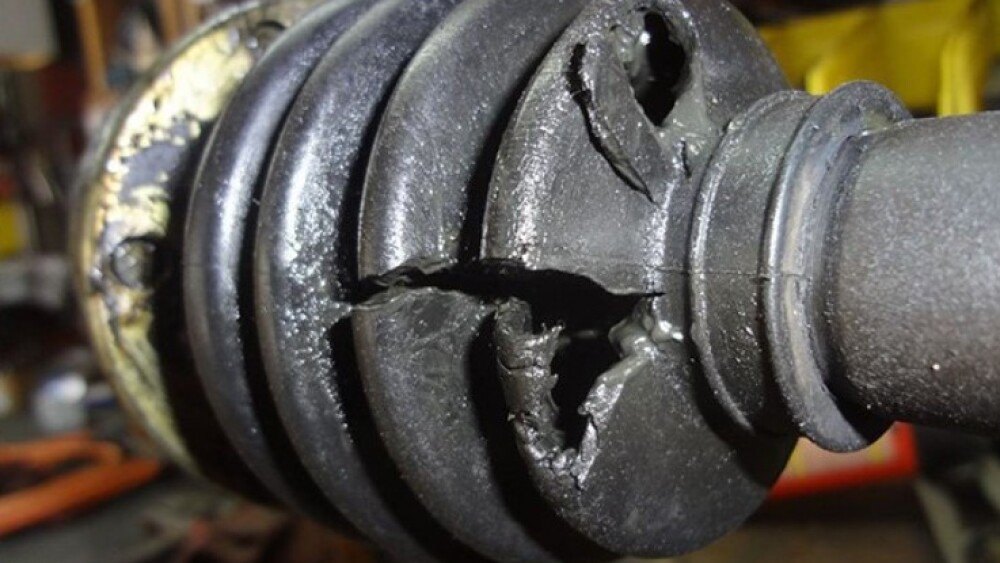
Over time, CV joints can split at the seams from normal wear, and they can be punctured by loose road debris or while driving over rough terrain. Typically, cracks from normal wear appear first on outer CV boots closest to the wheels because they are subject to a greater range of up-and-down motion, plus the increased heat from the brakes.
As far as foreign elements messing with CV boots, damage occurs while driving through hard-packed snow or on roads covered with large gravel or stones. Off-roading over rocks or through water greatly increases the likelihood of damage, too.
Regardless of how damage occurs, the end result is the same. Grease packed inside a boot will leak out as the axle rotates, and dirt and moisture will work their way in. Without proper lubrication, abrasive grit and corrosion from water eventually cause a CV joint to wear to the point where it’s compromised and must be replaced before complete breakage occurs.
Periodic inspection of your CV boots is a good idea as it’s possible to spot a small crack or tear early on before a CV joint becomes compromised. While larger punctures will result in dark-colored grease being visibly splattered all over, catching the problem sooner rather than later means you’ll be able to get away with replacing only the CV boot itself. A whole new CV joint is a considerably more expensive part to replace if the problem is ignored.
A faulty outer CV joint will make a popping or clicking noise as your steering wheel is turned, and the sound will become louder as you accelerate around a corner. While inner CV joint failures aren’t as common, symptoms include shimmying or shaking from side-to-side as you accelerate. There may also be a clunking sound when moving the changing gears in a manual transmission or moving the gear selector in an automatic.
Replace The CV Boot, Not The Whole Joint
Before digging in, take a look at CARiD’s resources for CV joints, boots, and components. Got a good glimpse? Great!
Now, let’s go over the steps involved in replacing one, plus any necessary other components or hardware. If you plan to use a mechanic to make the repair, you might consider being prepared with a new replacement CV boot on your end so you’ll pay only for labor.
A CV Joint Boot Kit
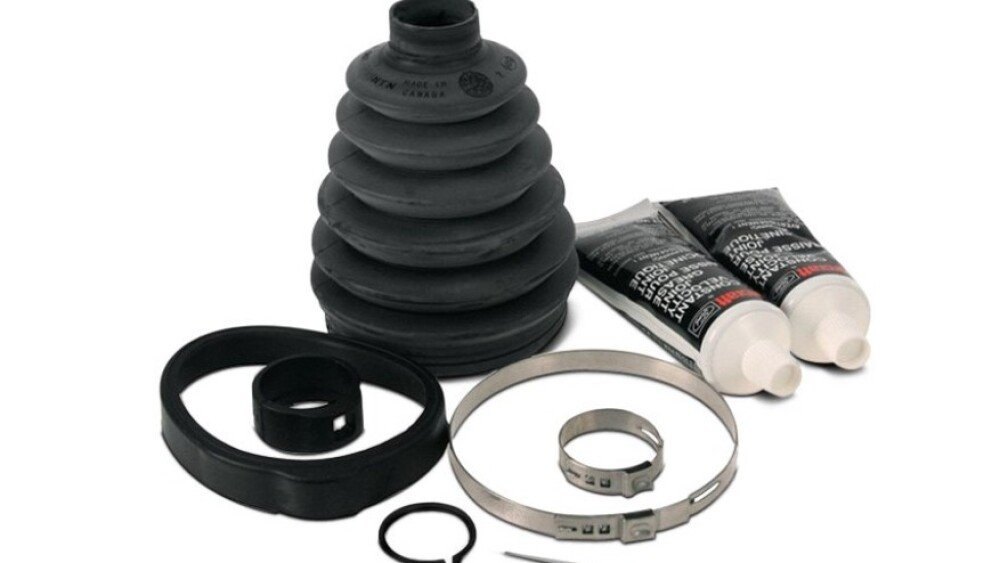
The CARiD website will automatically ensure that the CV boot is designed for a tight fit on each specific vehicle. Unless noted, all CV boots are vehicle-specific. Ones that are designed to fit any vehicle are noted on the product page as universal fit. Opting for a vehicle-specific product is recommended since it ensures proper fitment and reliable sealing.
Material and Fitment Matter
The material used in CV boots is exactly what directly influences their quality. They are manufactured from different rubber compounds and other materials, and it’s often hard to say how long your new part will last, even if it looks to be good quality. For instance, low-quality boots may only stay in good shape until the first frost of the season, as many of them cannot withstand cold temperatures. To avoid such problems, we source our inventory from trusted brands.
A popular option is the Dorman CV Joint Boot Kit which fits a wide range of American, Japanese, and Korean vehicles made before 2011. We have a variety of Mopar CV joint boot kits for cars, SUVs, and trucks manufactured from 1985 onwards.
Motorcraft CV Joint Boot Kits cover Ford/Lincoln/Mercury models back to 1986. For newer Saabs, we’ve got the Professional Parts Sweden CV Boot Kit. You’ll also find a wide range of aftermarket offerings for Chrysler division models (including Jeeps) with the Crown CV Joint Boot kit. Meyle’s CV Joint Kit focuses on various German-made cars from 1987-present. If you’ve got a classic German car, Febi’s replacement CV joint boot kit provides good product coverage. A popular product for Volkswagens made in the 1950s-70s is the Beck Arnley CV Joint Boot Kit.
Vaico CV boot kits provide good coverage for Mercedes models from 1986 on, along with later BMWs, VWs, and Audis. For a wide range of newer vehicles in addition to popular American and Euro classics, we’ve got the CV Joint boot kit by EMPI, along with Moog CV Joint Boot Kits and Rein CV Joint Boot Kits designed for BMWs back to 1969. And if you can’t locate boots for your specific vehicle, we’ve got the universal-fit CV Boot by RCV Performance.
Heavy-Duty CV Joint Protection
Many of our staffers at CARiD are off-road enthusiasts - we’re familiar with putting parts to the test. This means we know how unforgiving rocks, fallen branches, and other hazards can be - especially to CV boots in extremely vulnerable positions. Whether you travel over rough terrain by choice or by necessity, you need replacements that offer a higher level of protection. We’ve got a number of choices.
If you regularly find yourself in any of these situations, we’ve got the heavy-duty CV boots you need.
The main difference is the material. Enhanced neoprene or silicone-based compounds may be used, which are much more difficult to puncture than rubber. Also, these types of boots have higher resistance to rotting. Many of them are offered by Dorman, RCV Performance, and Megan Racing.
We’ve also got CV axle boots made of hearty polyurethane – another material that’s extremely durable in off-road situations. There’s the RCV Performance Spherical Sealing Technology CV Joint Seal suitable for full-size American trucks or Jeeps.
How to Replace an Outer CV Boot

Since outer CV boots need replacing far more often than inner ones, we’ll look at the process of replacing an outer CV boot. Once the wheel is removed and the axle shaft is freed from its anchor point, sliding the old one off and the new one on is relatively simple. Below, we’ll start from the point where lug nuts/bolts have been loosened.
Step 1: Remove the Axle Nut from the Center of the Wheel
With a socket, or with the help of an air tool, loosen the axle nut located in the center of the wheel. In many cases, it’s possible to do that with the wheels on the ground. If the wheel is already removed, the nut can get loose if you block the brake rotor against the caliper, with a screwdriver or a similar tool. The nut and wheel should be removed from the vehicle.
As for the caliper, it can usually be moved aside without disconnecting the brake hose; just unscrew one or two bolts that keep the caliper in place. If it has to be separated, keep it supported with a hook or bungee cord to avoid putting too much stress on its line.
Step 2: Disconnect the Steering Tie Rod
Underneath the steering tie rod linkage connection, you may see a threaded stud with a cotter pin in it. Use a pair of needle nose pliers to grab and remove the cotter pin. Once the pin is out, you can loosen and remove the nut.
Next, you’ll need to whack the end of the threaded stud to break it loose and remove it. In order to prevent damage to the stud or the threads on it, use a heavy plastic mallet instead of a metal hammer (in some applications, you can use a pickle fork). If you don’t have a plastic mallet, use a piece of wood to cushion the impact between the hammer and the ball joint stud.
Step 3: Remove the Sway Bar Link Rod
To ensure you are able to push the lower control arm all the way down (in a future step), temporarily disconnect and remove the sway bar link rod that connects the sway bar to the lower control arm. These link rods use standard bolts on both ends, so the removal should be relatively straightforward.
Step 4: Disconnect the Lower Control Arm
To free the ball joint at the end of the lower control arm so it can be disconnected, you’ll need to loosen a long, horizontally positioned bolt and slide it out. Tap downward on the lower control arm with a hammer in order to break the pin at the end free from the steering knuckle that the wheel and brake components mount to. The pin should slide down and out.
Step 5: Disconnect the Steering Knuckle From the Axle
Once you’ve removed the pin in the previous step, the steering knuckle can be moved around enough so that the axle can be pulled loose from the splined hole in the knuckle.
Step 6: Remove Old Ring Clips / Bands
Loosen the old metal bands with a screwdriver or pliers, then slide them off.
Step 7: Remove the Old CV Boot
Using a pair of channel locks or a razor blade, cut the old boot away and remove it from the axle shaft. Wipe as much of the old grease away as possible with a rag, then spray it with cleaning solvent to thoroughly remove any gunk that remains.
Step 8: Install Your New CV Boot
There are several ways to do this, depending on your vehicle’s design and the need to take the CV joint off for cleaning and inspection. A simple method allowing you to avoid splitting or removing the joint when installing the boot is the use of a special plastic funnel. First, take your new CV boot and flip it inside out. Next, take the funnel, coat the outside of it with grease, then insert the wide end of it over the axle CV joint. Most kits come with a tube of axle grease, so go ahead and use that.
Take the inside-out CV boot and slide it (wide end first) up over the lubricated funnel until it completely passes over the funnel. Correct the inside-out, inverted orientation by grabbing the wide end of the boot and flipping it over as you pull it back toward you. Once that’s done, it will be positioned correctly for installation. Pack fresh axle grease into the CV joint.
Step 9: Install New Ring Clips / Bands
You’ll be installing two bands on your new CV axle boot - one on the larger outboard side, and one on the smaller inboard side. After positioning each band in place, pull the banding tight. Create a bend by pulling the extra banding back the opposite way. With a pair of pliers, bend the retaining tabs over this extra banding and cut off the excess that’s left over.
Step 10: Cut Away Any Extra CV Boot Material
Using a razor blade, box cutter, or any cutting tool, neatly trim off the excess CV boot material. If a vehicle-specific boot is used, this step is not needed, as the part is of the right length.
Step 11: Reinstall All Components
Reinstall all steering and suspension components in the reverse order you disassembled them, until the wheel is bolted securely onto the vehicle.
Important: look up the torque specs for the fittings on your vehicle, and use a torque wrench to tighten all nuts and bolts to the correct torque.
We recommend taking a short test drive, and then re-inspecting the new boot to make sure it’s still tight without leaks of any kind.
Common Recommendations
CV boot kits are an efficient, cost-effective way to repair an axle with a damaged boot. As a best practice, inspect your CV boots regularly (at a minimum, every oil change, and more frequently if you drive off-road). Even if you notice small cracks in the rubber, don’t wait too long to make the repair - the boot will likely tear soon. By replacing it as soon as possible, you can be sure that no dirt makes its way in. The goal is to capture and repair any boot damage before it extends to the CV joint itself!
Buying Replacement CV Boots the Easy Way at CARiD
CARiD has a Shop by Service Type tool that lets customers search for the type of work their vehicle needs, and pinpoints exactly what’s needed by selecting their own make, model, and year. We carry a massive variety of engine parts and swap tools by reputable brands, as well as everything you need to revamp anything that your engine may need.
FAQ
Can you drive with a torn CV boot?
You can, but it’s a good idea to replace it as soon as possible. The longer its torn, the higher the likelihood that moisture and dirt will get in there and destroy the CV joint, leading to a far more costly repair - both in parts and labor.
What are the symptoms of a bad CV boot?
You might see grease splattered all over your wheel well, but there are other telltale signs. You might hear a faint popping or clicking noise as your steering wheel is turned and become louder as you accelerate around a corner. If it’s the inside boot, it’ll shimmy and cause a vibration.
What happens if a CV axle breaks while driving?
This will mean that the wheel will lose drive, which could leave you stranded. When it breaks, it could cause catastrophic damage to other components in the area, such as the brakes, brake lines, differential, transmission, and so on. In addition to the increased cost, this is why doing a simple boot replacement as soon as possible is such a good idea, as it could cause a dangerous situation.
How long does it take to replace a CV boot?
Typically, it’ll take anywhere from one to three hours depending on the complexity of your vehicle’s drivetrain, as well as steering and suspension systems. Or, if you’re a quick wrench, it could take much less.