

Older vehicles with spark ignition systems rely on a distributor and a key component called the distributor cap to ensure proper voltage distribution to the spark plugs for efficient engine ignition. If this cap fails, your engine may not start or could experience serious issues.
In this article, we discuss the signs of a failing distributor cap to help diagnose your vehicle and determine whether the cap needs to be replaced.
What are the Signs of a Bad Distributor Cap?
The distributor cap is a maintenance part that will likely develop cracks, corrosion, or carbon buildup over time. These issues can disrupt the flow of electricity to the spark plugs, leading to misfires and rough running.
The simplest way to tell if the distributor cap has gone bad is by performing a visual inspection. You may also observe one or more of the following symptoms:
Hard Starting
The same issues that cause misfires and rough running can also make it harder to start your car. Carbon deposits, moisture, or cracks in the distributor cap can lead to voltage loss or short circuits. This may contribute to hard starting, especially during the colder months when these issues tend to be more pronounced.
Engine Stalling or Backfiring
Sometimes, a faulty distributor cap can prevent your car from starting, especially if there’s internal damage. Worse, the engine may unexpectedly stall or backfire due to improper voltage delivery to the spark plugs.
Check Engine Light
There are a variety of issues that could trigger the check engine light, and a faulty distributor cap is one of them. The warning may illuminate when the cap is cracked, corroded, or experiencing issues that could lead to incorrect voltage distribution.
What Does a Distributor Cap Do?
Now that we’ve enumerated some of the symptoms of a failing distributor cap, let’s discuss what a distributor cap does to better grasp its role in your ignition system.
What is a Distributor Cap?
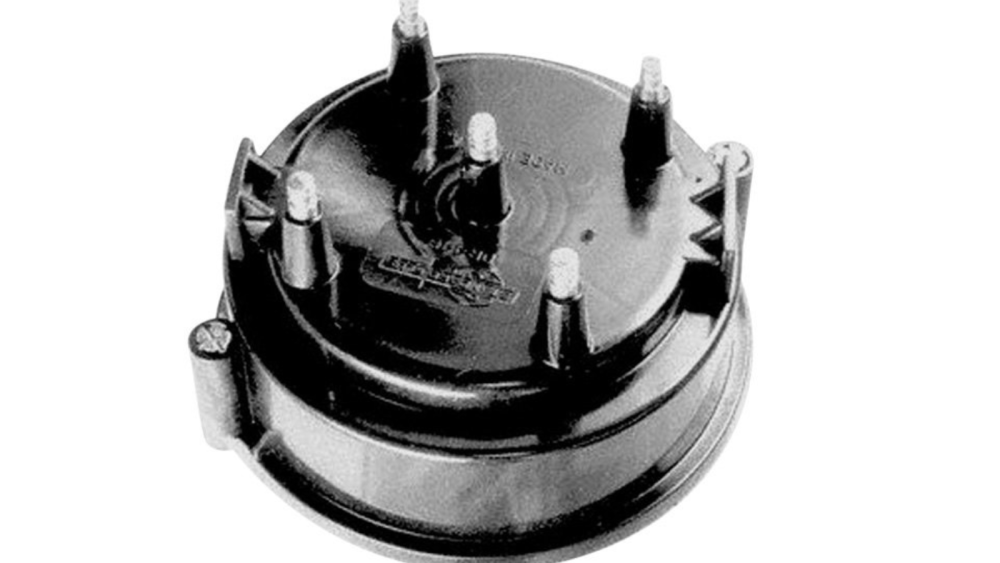
When an engine starts, a significant amount of voltage is generated within a vehicle’s ignition system. In distributor-style ignition systems, the distributor cap is a small plastic component with metal electrodes that plays a crucial role in this process.
The cap is usually black, gray, or red, and looks like a crown with terminals on top. It is also connected to black wires that help safely and efficiently deliver power to your engine.
How Does a Distributor Cap Work?
So what does a distributor cap do? To help understand how the cap on the distributor works, let’s break down the process:
Voltage Transfer: During engine startup, the ignition coil sends high-voltage power to the center of the distributor cap. The rotor within the distributor rotates, sequentially directing the voltage to each metal terminal of the distributor cap.
Connecting to Spark Plugs: Each metal terminal connects to a wire that serves as a pathway for electricity, allowing it to travel from the distributor cap to each of the engine’s spark plugs.
Ignition Process: The power reaches the spark plugs in sequence, creating a spark at the plug’s tip to ignite the air-fuel mixture for a controlled burn. This expands the inert nitrogen that makes up the majority of the air in the cylinder. That expanding nitrogen acts against the head of the piston and its connecting rod, doing its part in turning the crankshaft.
Where is the Distributor Cap Located?
The distributor cap is typically found under the hood of your vehicle. You can locate it near the engine, right on top of the distributor. If you’re not sure where to find the distributor cap, simply follow the spark plug wires or check your vehicle’s manual.
Distributor Cap Replacement Cost
If you’re performing the replacement yourself, the distributor cap itself typically costs anywhere between $3 to almost $250. However, if you decide to have a professional mechanic do the replacement for you, you can expect the cost to be around $75 to $200. This can vary depending on the vehicle’s make, model, and year, as well as average labor rates in your area.
FAQ
Can you clean a distributor cap?
Yes. Tools like a sharp screwdriver and a scrub sponge can be useful for getting rid of any residue and contaminants that could obstruct the airflow in the distributor cap or harm the rotor blade. However, be careful when cleaning the rotor’s center spring so as not to wear down the cap’s carbon contact.
How long do distributor caps last?
The average lifespan of distributor caps is about 1 to 2 years or 12,000 to 24,000 miles, depending on driving styles, conditions, and maintenance frequency. However, it is advisable to have a comprehensive vehicle tuneup every 2 years to ensure that the distributor cap is in tip-top shape and prevent unexpected vehicle issues.