

Does something feel off whenever you step on the gas? If you notice symptoms like inconsistent acceleration and/or deceleration, and perhaps an illuminated check engine light, you may have a problem with your accelerator pedal position (APP) sensor.
In this guide, we cover what the APP sensor does, the warning signs you might run into when it goes bad, and how it impacts your vehicle’s performance. It also breaks down the cost of replacement and what to expect during repairs.
What are the Signs of a Bad Accelerator Pedal Position Sensor?
How can you tell if your APP sensor is bad? There are a few common symptoms, including an illuminated Electronic Throttle Control (ETC) light along with the Check Engine Light. Some platforms will also have the Wrench light and Throttle Body light on as well.
Typically, issues related to the throttle body (which include APP sensor issues) will manifest as a limited throttle response—or no throttle response at all. This safety measure is programmed into the system to prevent unintended acceleration or “runaway” situations.
Illuminated Check Engine Light
If there are issues with your APP sensor, one of the first signs you may notice is the illumination of the check engine light, along with the ETC light. These warning indicators come on when the powertrain control module (PCM) detects problems with the engine, but when the throttle body is the principal reason for the light, it’s a special case.

Inconsistent Acceleration or Deceleration
The accelerator pedal is monitored by redundant sensors that provide slightly different signals to enhance reading accuracy and detect potential faults. The position data is sent to the ETC, which adjusts fuel delivery to meet the demand for higher or lower speeds.
If the redundant sensors disagree on the pedal’s position, a warning light will illuminate, and throttle response will be reduced as a precaution.
Activated Limp Home Mode
When the PCM detects a severe issue due to the APP sensor, it will activate the limp home mode—a safety feature that reduces engine performance to prevent engine damage.
In this mode, the engine will move at a snail’s pace, and systems that consume a lot of power like the A/C will be disabled. If the limp home mode is activated, you’ll need to replace the faulty APP sensor as soon as possible.
Failure Modes
- Limit Performance Mode - is typically activated when the engine’s output is detected as impaired. The maximum throttle angle is reduced, throttle blade control is slowed, and the warning lamp is activated.
- Forced Idle Mode - is activated when driver intent can’t be determined. This is usually when the accelerator pedal position sensor connector isn’t plugged in, or if there is no data or faulty data from the APP sensor.
- Power Management Mode - is activated when the ETC system cannot reliably control the engine power using the throttle. The throttle is disabled so the throttle blade can return to the default position.
- Engine Shut Down Mode - is activated when the ETC system is unable to reliably process the control algorithms or cannot control the engine power.
What Causes the Accelerator Pedal Sensor to Go Bad?
Accelerator pedal sensors can go bad because of faulty sensor elements, cables, electronic connections, and evaluation units. Inspecting these components can help you determine the root cause of the bad APP sensor. Here’s each cause in more detail:
Damaged Sensor Element
The APP sensor has a wiper arm to keep it free of dirt and debris. Unfortunately, this wiper arm can also wear down the sensor element and cause damage.
Faulty Cables
Cables and connections can wear down over time. Check the cables connecting the APP sensor and the ETC for signs of wear.
Faulty Electronic Evaluation Unit
The electronic evaluation unit is responsible for checking the APP sensor for issues. If this specific part is damaged, it can mislabel the entire sensor as faulty.
Insufficient Voltage and Ground
Electronic components like sensors need sufficient power and ground connection to function and protect them from power surges.
What Does an Accelerator Pedal Sensor Do?
The accelerator pedal position sensor monitors the position of your accelerator pedal at any given time and sends the data to your vehicle’s ETC. The ETC then uses the data to calculate a throttle angle that matches driver intent.
There are always at least two redundant sensors, and their readings should agree at all times, even though they operate at different voltage thresholds. The scan tool screen capture below illustrates the way this looks over time.
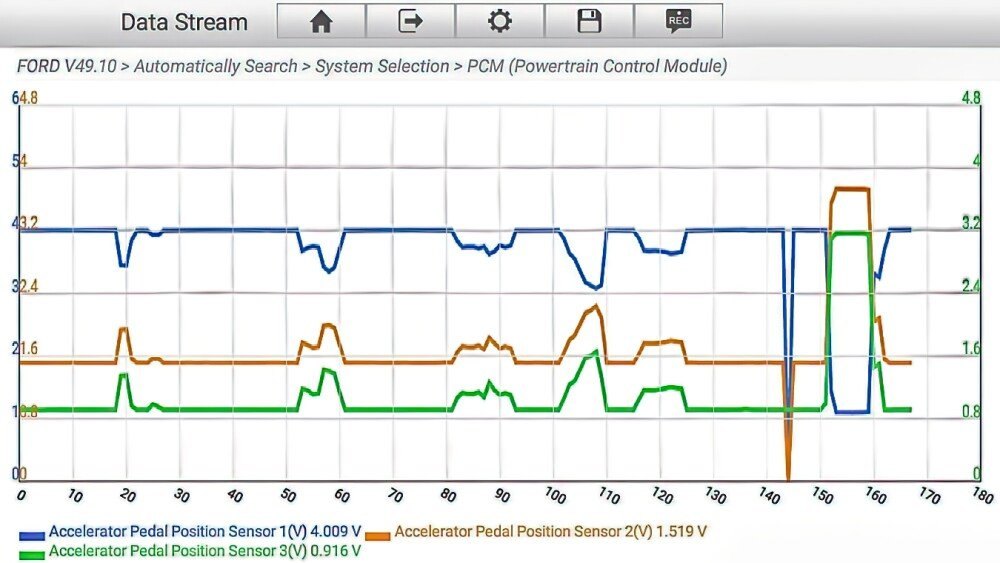
The PCM/ECM (engine control module) collects this data and sends it to the ETC module.
If the APP sensor is faulty, it will send non-redundant signals, which prevents the PCM/ECM from determining what it should do with the throttle body controls. When that happens, it limits the throttle or prevents the throttle from opening at all.
APP sensors have a stator and a rotor or a potentiometer—the output signal may be digital or analog, depending on the type of sensor.
The rotor is the moving part of a machine, similar to those found in motors and generators. The stator, on the other hand, is a complex component made of coils and an electronic evaluation unit that monitors the sensor’s status. Digital APP sensors are typically non-conductive devices, meaning their internal components do not need to make physical contact during operation.
Where is the Accelerator Pedal Sensor Located?
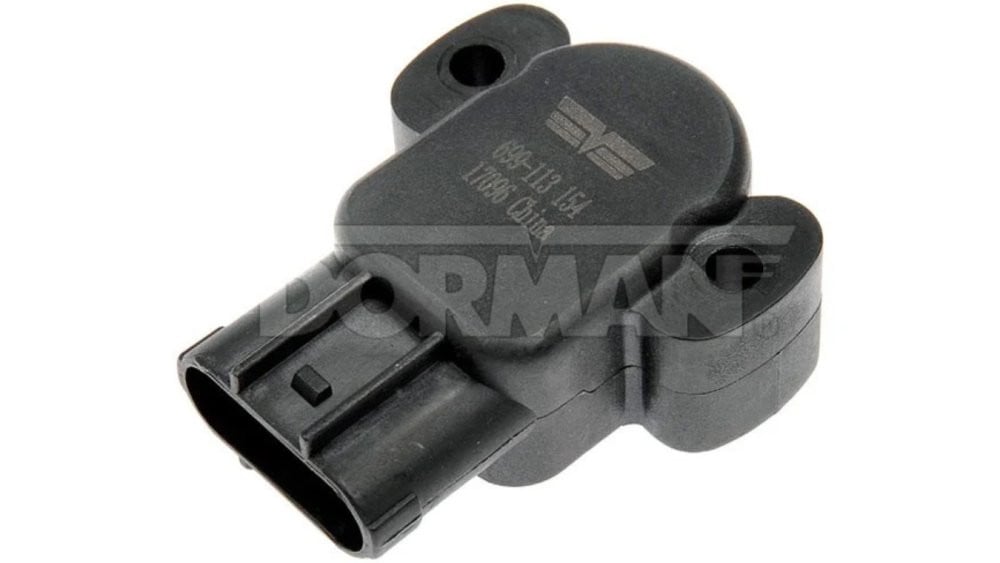
The APP sensor is typically located on the accelerator pedal assembly, on top of the pedal. In some vehicles, the APP sensor may be located on the engine bay or on the throttle body.
Accelerator Pedal Sensor Replacement Cost
APP sensors typically cost anywhere between around $20 to $400. The price of this component depends on a variety of factors, including brand name, materials, and more. Some sensors are sold with inclusions like accelerator pedals and installation hardware.
Labor costs should be under $100, although this is just a rough estimate and can vary depending on where you go, and a few other factors.
FAQ
How long does an APP sensor last?
APP sensors often last for the entire service life of the vehicle. However, these components can also wear prematurely or sustain damage due to accidents.
What is the normal range of a Mercedes accelerator pedal sensor?
The normal operating range for the APP sensor is 0.5-4.0 volts, with 5 volts of power supply coming from the ECU. However, it’s best to get more information about the normal range of the accelerator pedal sensor on your Mercedes-Benz from your owner’s manual or a reliable repair manual for your vehicle’s specific model.