
WHAT IS STEEL WHEELS?
Steel is both heavier and stronger than aluminum, and has been used for wheel construction a great deal longer. Steel bends and becomes damaged much less easily than alloy. Because steel is already so strong, further casting or forging methods are generally not necessary. Most steel wheels are stamped out by massive presses and then welded together to form the wheel, as in these steel racing wheels. The downside to this is that steel will not allow for the kinds of spoke and face designs that make allow wheels such an artistic platform on the car.
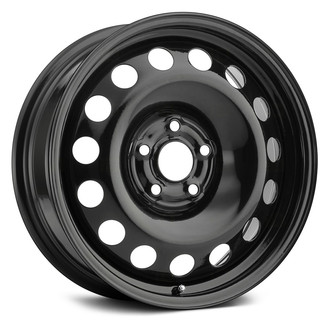
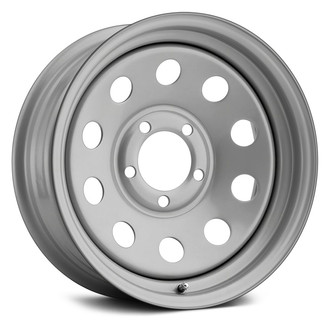
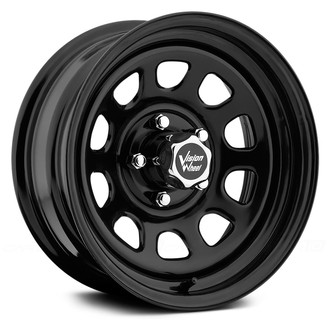


For the most part all one can do with steel faceplates is to stamp some windows in them for brake cooling purposes. However, several companies nowadays are working hard on creating steel wheels that are chrome-clad, meaning that they have a thin overlay, usually made of tin, which has been chromeplated and then glued on the face of the wheel.
- Steel Wheels Particular Qualities
-
The weight of wheels, tires, brakes, and rotors is specifically called “unsprung weight” because it is not being cushioned by the suspension springs. Unsprung weight has much more effect on how the car handles than an equivalent amount of weight above the springs, such that even a small change in weight can have large effects.
- Steel wheels are heavier than aluminum, so when you put steel wheels on a car that has had alloy wheels, you tend to find that the extra weight dampens acceleration and agility, lowers the car's center of gravity and in general makes it drive more like a tank. Obviously, this can be undesirable for summer performance applications, but in the winter the effect can be a significant physical and psychological advantage. Heavier wheels will make tires bite the snow harder, and when driving in snow, having a car with dampened acceleration and agility, an artificially low center of gravity and a sense of solidity and heaviness can be a very good thing.
- Steel wheels are significantly stronger than alloy wheels. It takes a great force to bend steel wheels, and it is almost impossible to crack them. Given their usual utilitarian look, the purely cosmetic damage is not generally a major issue.
- There are wheel covers that you can put on steels to make them look like alloy wheels; they often come on steels sold as OEM choices and can be found online as well. Wheel covers are fragile, look kind of cheesy, and are most often held on by a spring steel friction grip that has a distressing tendency to come off at inconvenient times and roll away.
- Steels are generally only made in 16” sizes or less. There are a very few 17” steels out there, but not a single 18” steel that I know of. I would imagine that an 18” steel would be ridiculously heavy. Consequently, putting on steels will often involve downsizing. Some high-performance cars will not accept downsized wheels because of oversized brake calipers or other suspension issues.
- Steels are also usually 75-80% less expensive than alloy wheels, making them great for a second set, and inexpensive to replace if badly damaged.
Thus for many reasons alloys are the only choice when high performance and/or looks are the qualities you need. Steels are generally better for those no-nonsense daily drivers, or for any cars that don't have to look pretty or do fancy maneuvers because they work for a living. They are especially ideal, however, for that extra set of winter wheels.