TPMS GUIDE
- TPMS benefits
- Increased wear and consumption
- Principles of TPMS
If your car seems to be running smoothly, you can get by with checking your tire pressure. Tires lose about one PSI every month after filling them, so checking every month can help to ensure that they are always inflated to the proper pressure.
TPMS BENEFITS
It is recommended to check tire pressure weekly, though, as well as before any long road trip to ensure that your tires are properly filled. To know how many pounds per square inch (psi) of air your tires should be, you can look in two places: in your driver’s manual, or the chart inside you driver’s side door. A numerical value will be listed, and you can adjust most digital air pressurizers to that number.
Vehicles with properly inflated tires experience optimum:- Improve vehicle handling
- Reduce braking distances
- Decrease tire wear
- Lower the risk of hydroplaning
- Save money at the pump through improved fuel economy
Low tire pressure has many negative effects on your car. Here are some dangers of using tires that are under-inflated:- Increased wear and tear on the sides of your tires
- Less responsive to steering
- Less efficient braking
- Tread breakdown
- Tire separation from rim
- Damaged rim or axle
USING TPMS WILL GIVE YOU:
- DRIVER SAFETY
-
When your tires are underinflated, they can’t perform well on the road. An estimated nearly 700 vehicle crashes are caused by underinflated tires every day. The National Highway Traffic Safety Administration (NHTSA) reports that tires under-inflated by 25% cause three times as many car accidents as correctly inflated tires.
- EFFECTIVENESS
-
Safety studies have shown that the presence of TPMS resulted in a 55.6% reduction in the likelihood that the vehicle would have one more severely underinflated tires (NHTSA).
- FUEL SAVINGS
-
Properly inflated tires save the typical passenger car 9.32 gallons of fuel, and over an entire year, TPMS saved approximately $511 million for the TPMS-equipped vehicle population (NHTSA).
- If the driver ignores tire pressure for a month – tires naturally lose 1 PSI to 2 PSI per month – the resulting pressure drop could reduce fuel economy to 23.1 MPG, on average.
- Changing from summer to winter, a typical drop of 50°F translates to about 5 PSI under inflation. In addition to the cold-weather fuel economy impact, the extra rolling resistance will reduce fuel economy to just 20.3 MPG.
- ENVIRONMENTAL
-
According to the Environmental Protection Agency, Americans drive an average of 12,000 miles a year. With an average of 20 pounds of C02 emitted per gallon of gasoline consumed, the typical passenger car in the U.S. releases over five tons of CO2 into the atmosphere each year. Driving on properly inflated tires reduces your fuel consumption and carbon footprint.
- Fuel consumption increases by 1% every 2,9 psi / 0.2 bar the tire is
under-inflated.- 0,4 bar under-inflation -> 2% increase in fuel consumption
- 0,6 bar under-inflation -> 3% increase in fuel consumption
- Tire wear increases by 5% every 2,9 psi / 0.2 bar the tire is underinflated.
- 0,4 bar under-inflation -> 10% increase in tire wear
- 0,6 bar under-inflation -> 15% increase in tire wear
According to NHTSA: Tire wear increases by 15% every 2,9 psi / 0.2 bar the tire is under-inflated.
- Notice for tire pressure devices
- 0.08 bar at calibration
- 0,16 bar in use
- Notice for driving and environment influences
- 0,1 -0,3 bar pressure boosting by driving
- Until to 0,5 bar pressure fluctuation through the change of the ambient temperature
Notice for acceptance by the driver: Drivers do not accept pressure variations <0,3 bar
- Fuel consumption increases by 1% every 2,9 psi / 0.2 bar the tire is
Tire Pressure Monitoring Systems (TPMS) work by different physical principles:
1. Direct TPMS
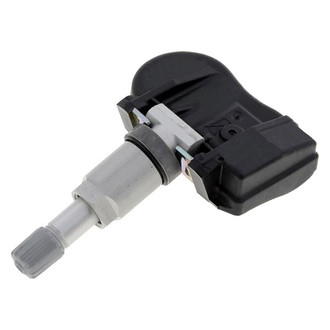
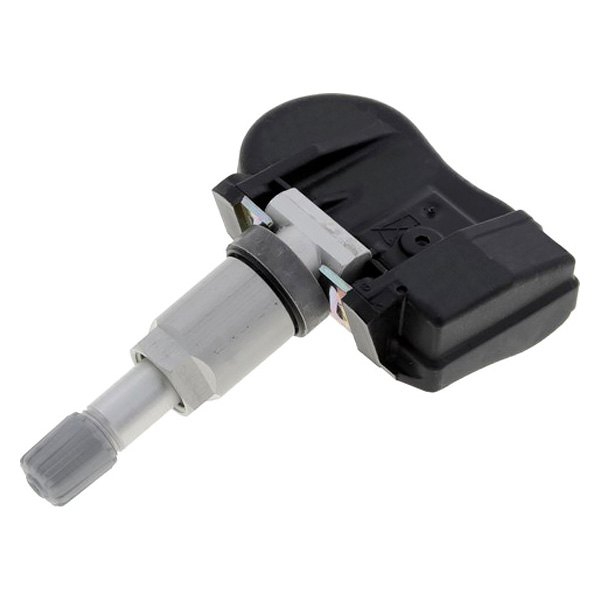
Direct TPMS are measuring the pressure directly, by having a wheel electronic which measures the pressure and transmits it by radio frequency (RF) from the tire to the chassis.
2. Indirect TPMS
Indirect TPMS are measuring pressure indirectly, by using information from other vehicle- related sensors (e.g. ABS wheel speed sensor information) and evaluating these signals. Principles are:
- Comparison of wheel speed signals
- Analysis of resonance frequency shifts
- Comparison of wheel speed signals with absolute speed measurements (e.g. from GPS)
- Analysis of correlation patterns between wheel speed signals.
- Analysis of vertical accelerometer signals.
- Analysis of measured tire forces.
- Analysis of differences in responses to load shifts.
- Analysis of footprint