
Safe Driving Tips
- Keep Your Tires Safe
- Drive safely through any situation
- Winter driving
- Wear on Both Edges
-

Underinflation:
Reduces tread life through increased treadwear on the outside edges (or shoulders) of the tire
Generates excessive heat, which reduces tire durability and can lead to tire failure
Reduces fuel economy through increased rolling resistance (soft tires make your vehicle work harder)
Solution:
Add air to your tire until it reaches the proper air pressure (psi, as measured by an air pressure gauge). To find the proper air pressure, consult your vehicle’s owner’s manual or find your recommended psi on the sticker on your door jamb
Uneven Wear

Poor Alignment
You need an alignment when you notice:
- Uneven front or rear tire wear
- Changes in your vehicle's handling or steering response (e.g., pulling to one side)
Solution:
Many vehicles today are equipped with rear suspensions that can be adjusted for alignment. If this is the case, your vehicle may need a "front end" alignment or a "four wheel" alignment, depending on the symptoms you are experiencing.
Scalloped

Poor Alignment
You need an alignment when you notice:
- Uneven front or rear tire wear
- Changes in your vehicle's handling or steering response (e.g., pulling to one side)
Solution
Many vehicles today are equipped with rear suspensions that can be adjusted for alignment. If this is the case, your vehicle may need a "front end" alignment or a "four wheel" alignment, depending on the symptoms you are experiencing. See your local Michelin authorized tire dealer for service and inspection.
Overinflation issues:
- On an overinflated tire, the center of the tread bears most of the load and wears out faster than the outside edges.
- To prevent overinflation, always check tires when they’re cold or before they’ve been driven.
- Or, check tires at least three hours after they have been driven.
Solution:
Take air out of your tire, using a tire pressure gauge, until your air pressure reading matches your vehicle manufacturer’s recommended psi. To find the proper air pressure, consult your vehicle’s owner’s manual or find your recommended psi on the sticker on your door jam.
Sawtooth or Feathered Edges
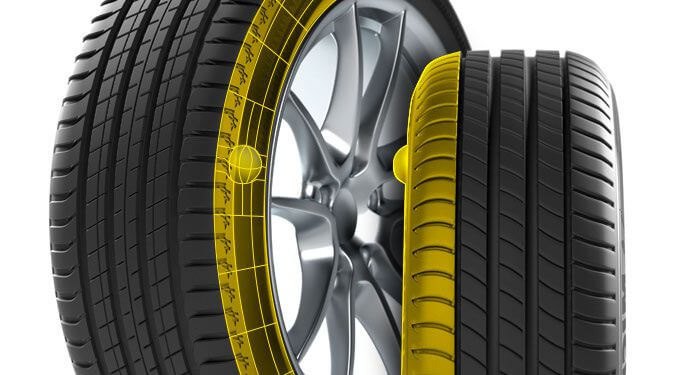
Misalignment
Misalignment issues:
- If a vehicle is misaligned, the edges of the tread have a sawtooth or feathered appearance.
- This is caused by erratic scrubbing against the road.
Solution:
Your car most likely needs a toe-in or toe-out alignment correction. (For more information on toe-in and toe-out alignment, see your local authorized Michelin tire dealer for helpful service.)
Wear in Center and Excessive Wear

Overinflation issues:
- On an overinflated tire, the center of the tread bears most of the load and wears out faster than the outside edges.
- To prevent overinflation, always check tires when they’re cold or before they’ve been driven.
- Or, check tires at least three hours after they have been driven.
Solution:
Take air out of your tire, using a tire pressure gauge, until your air pressure reading matches your vehicle manufacturer’s recommended psi. To find the proper air pressure, consult your vehicle’s owner’s manual or find your recommended psi on the sticker on your door jam.
Dips

Worn Parts
Worn parts issues:
- Cupping (also called dipping or scalloping) is most common on front tires.
- Rear tires can cup, however, as well.
Solution:
Worn parts may be a sign that wheels are out of balance or that suspension or steering system parts need service or replacement. Please see your local authorized Michelin retailer for helpful service and inspection.
Damage
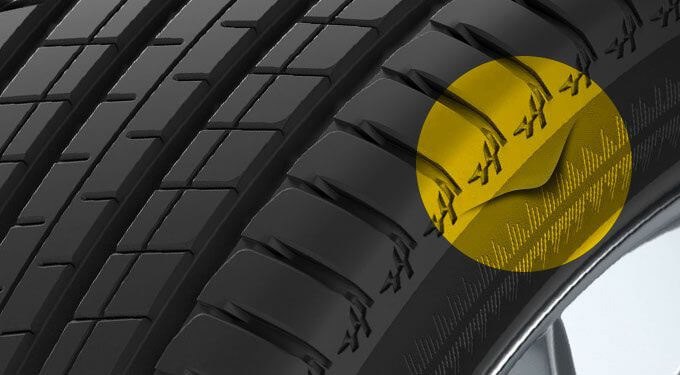
Damage That Requires Repair
Tire Damage Issues:
- Most punctures nail holes, or cuts up to ¼" confined to the tread may be repaired by trained personnel using industry-approved procedures.
- An on-the-wheel plug-only repair is not reliable and is dangerous because the inside of a tire must be inspected after a puncture.
Solution:
If your vehicle is equipped with one of the several types of temporary spares, replace your damaged tire with the spare, but be sure to first check the spare tire's sidewall for the correct inflation pressure, speed, and mileage limitations. Take your vehicle into an authorized Michelin retailer for an inspection as soon as possible.
The proper repair of a radial tire includes the placing of a rubber patch on the inner liner of the tire and a rubber filling of the hole by a professional. Do not attempt to have repaired tires with tread punctures larger than ¼" or any sidewall puncture. Also, do not have tires repaired that are worn below 2/32" tread depth.
Cups
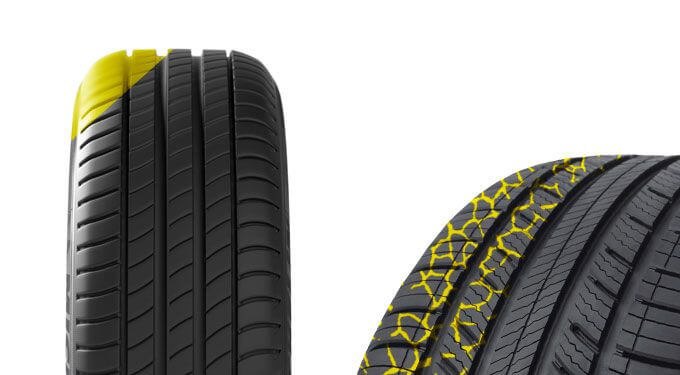
Worn Parts
Tire Damage Issues:
- Cupping (also called dipping or scalloping) is most common on front tires.
- Rear tires can cup, however, as well.
Solution:
Worn parts may be a sign that wheels are out of balance or that suspension or steering system parts need service or replacement. Please see your local authorized Michelin retailer for helpful service and inspection.
- Bar Across Tread
-

Worn-Out Tire
Worn-Out Tire Issues:
- All tires have treadwear indicator bars at 2/32" of remaining tread.
- When the tread is worn down to 2/32" or when you can see the treadwear indicator bars on any section of the tire, the tire is worn out and should be replaced.
Solution:
Take your vehicle into an authorized Michelin retailer for an inspection and have a professional measure the remaining tread with a tread depth gauge.
- Tire pressure
-

How to check tire pressure
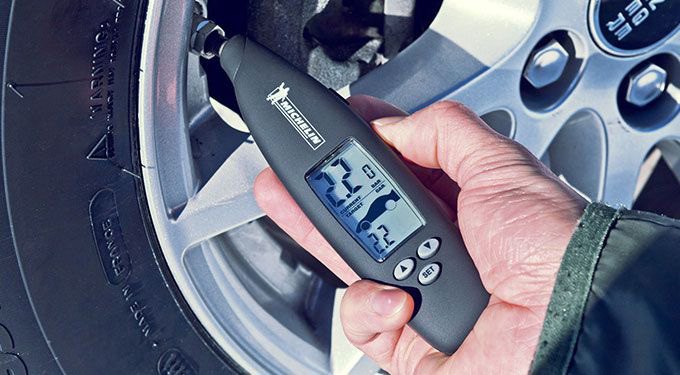
Tires have been known to lose up to 1psi (pounds per square inch) every month, so check all tires, including your spare, once a month (or before a long trip). It’s easy. Here’s how:
- Purchase a trusted tire pressure gauge.
- Check your tires “cold” – before you’ve driven or at least three hours after you’ve driven.
- Insert tire pressure gauge into the valve stem on your tire. (If you are using a digital tire gauge like the one pictured, the gauge should begin reading the air pressure immediately. Refer to your air pressure gauge owners manual for correct usage instructions. If using a "pencil" style tire gauge, the gauge will “pop” out and show a measured number. When you hear a “pssst” sound, that’s air escaping the tire. The escaping air shouldn’t affect pressure substantially, unless you hold down the air pressure gauge too long.)
- Compare the measured psi to the psi found on the sticker inside the driver’s door of your vehicle or in owner’s manual. DO NOT compare to the psi on your tire’s sidewall.
- If your psi is above the number, let air out until it matches. If below, add air (or have a Michelin retailer help you) until it reaches the proper number.
Nitrogen versus compressed air
Low pressure can lead to tire damage. See the inflation difference:
Most tires are filled with compressed air. But some tire retailers have started to put nitrogen into their customers’ tires. (Nitrogen is simply dry air with the oxygen removed. Air contains nearly 79% nitrogen already.) Because nitrogen replaces oxygen, less air can escape your tires, and your inflation pressure stays higher longer. Unfortunately, there are other possible sources of leaks (tire/rim interface, valve, valve/rim interface and the wheel), which prevent the guarantee of pressure maintenance for individuals using air or nitrogen inflation.
Nitrogen and compressed air CAN be mixed, if needed. Tires manufactured by Michelin are designed to deliver their expected performance when inflated with air or nitrogen, as long as the user respects the pressures recommended by the vehicle manufacturer on the vehicle’s placard or by the tire manufacturer.
- Mixing in new tires
-

Mixing in new tires with worn tires?
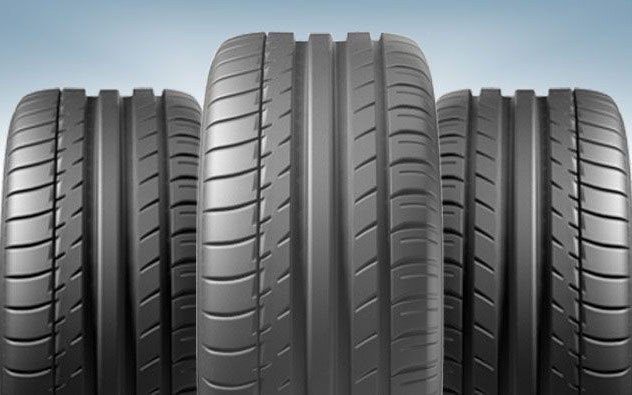
When replacing two new tires instead of four, be sure that your new tires are the same size and tire type as your current tires, and that your dealer always installs the new tires on the rear axle of your vehicle.
For continued optimized vehicle performance, it is recommended that all tires be replaced at the same time with identical MSPN.
Deeper tread tires on the rear axle provide better handling, wet grip, and evacuate water, thereby helping to avoid oversteer and loss of vehicle stability on wet surfaces. Deeper tread tires on the front axle can improve wet straight line braking and stopping distance. If only two tires are being replaced, Michelin generally recommends they be installed on the rear axle in the absence of a tire service professional's recommendation or consumer's preference to the contrary.
Replacing a single tire on a vehicle can have an adverse effect on suspension systems, gear ratios, transmissions, and tire treadwear. If a single tire replacement is unavoidable, it is recommended that the single new tire be paired with the deepest tread tire from the vehicle (including the full size spare) and both be placed as a pair according to the recommendations in the paragraph immediately above.
- How to inspect a tire
-

Once every month, or before you embark upon long road trips, check your tires for wear and damage problems. One easy way to check for wear is by using the penny test. All you have to do is grab an Abraham Lincoln penny and follow 3 easy steps.
- Take a penny and hold Abe's body between your thumb and forefinger.
- Select a point on your tire where tread appears the lowest and place Lincoln's head into one of the grooves.
- If any part of Abe Lincoln's head is covered by the tread, you're driving with the legal and safe amount of tread. If your tread gets below that (approximately 2/32 of an inch), your car's ability to grip the road in adverse conditions is greatly reduced.
For more serious problems, we’ve created an easy-to-use online tire inspection tool below to help you identify issues and learn how to fix them.
To make sure your car's tread is road ready, watch the video below to see the Penny Test in action

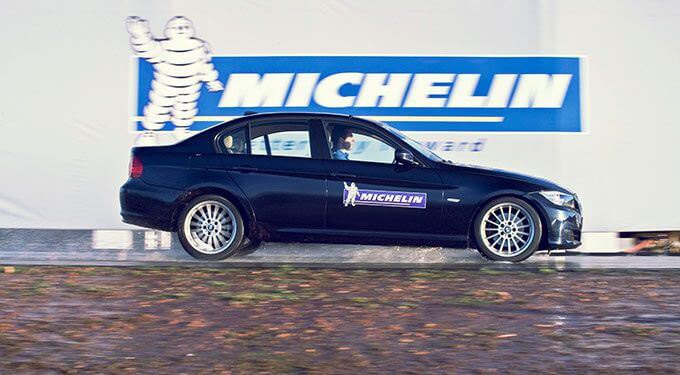
Slow down. If more drivers followed this tip in the rain, accidents would dramatically decrease. Wet weather doesn’t receive the same attention as winter weather driving, but it should. Wet roads present similar dangers-less grip and longer stopping distance, for example.
Here are some tips for driving safely on wet roads:
- Make sure your tires offer the proper amount of tread.
- Drive with two hands. Always.
- Slow down before turning, and maintain a consistent speed throughout the turn.
- While turning, don’t make any sudden steering wheel movements.
- Only brake in a straight line before the turn, and do so gradually. Be careful if you need to brake during the turn.
- Increase your following distance from other cars significantly.
- If hydroplaning, do not accelerate or brake suddenly. Keep your foot lightly on the gas and steer the car forward until your tires regain traction.
- Avoid sliding
-

What is it:
Your front or rear tires won't follow in the direction you are steering.
How to regain control:
Gently ease up on the gas pedal and slow down until the car regains traction.
How to avoid it:
Check the air pressure and tread depths of your tires monthly.
Driving tip:
Drive slower in rain or on wet roads.
- Braking in rain
-

Oversteer/Understeer:
These terms may be a bit technical, but bear with us. It’s easy and important. When you take turns in both wet and dry conditions (but especially wet), you can easily lose control by oversteering or understeering. Learn what these problems are and how to beat them by watching the video above.
- What to do if you slide forward instead of turning
-
What is it:
Your front tires lose traction and could slide right off the road before your rear tires. This is called understeering. Your car doesn’t follow the turn and slides straight off the road.
How to regain control:
Gently ease up on gas pedal and slow down until your tires regain traction.
How to avoid it:
- Check the air pressure monthly.
- Check the tread depth monthly.
- Avoid spinning out from a turn
-
What is it::
Your rear tires lose traction before your front tires and you start to spin.
How to regain control:
- If you have a front wheel drive: turn into the direction in which you are skidding. Remove steering correction as the rear axle begins to regain traction and straighten back up.
- If you have a rear wheel drive: ease up on the gas pedal and turn away from the skid. Remove steering correction as the rear axle begins to regain traction.
- If you have an all wheel drive: turn in the same direction that you are skidding and maintain light acceleration. Remove steering correction once the rear axle starts to regain traction.
How to avoid it
- Check the air pressure monthly.
- Check the tread depth monthly.
- Have your tires rotated regularly so that they wear evenly.
- If you purchase only 2 new tires, make sure they are placed at the rear of the vehicle.
Driving tip:
Do not turn too sharply.
- Avoid hydroplaning
-
What is it:
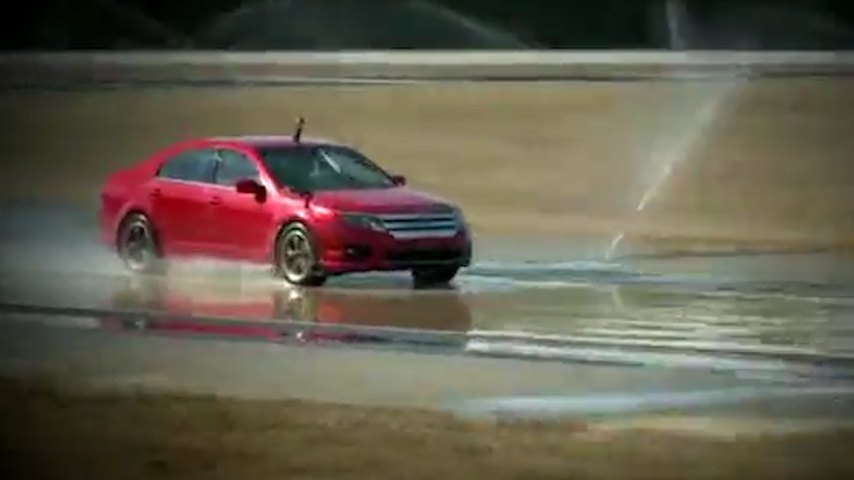
The tires slip and do not respond to steering, braking or accelerating. The vehicle can even skid or spin. It occurs when the water between your tires and the road cannot be removed quickly enough. This layer of water builds up in front of the tire until the tire cannot evacuate the water sufficiently. This is when the tire loses contact with the road.
How to regain control:
*** Don’t hit the brakes suddenly.
- Ease off the gas pedal gently until you slow down and regain traction.**
**
How to avoid it:
*** Check your tire pressure monthly. Tire pressure below 30% of what is recommended greatly increases the risk of hydroplaning.
- Check your tread depths monthly on all of your tires.
- Reduce your speed when approaching large puddles or standing water.**
**
Always stay safe. Take It From the Pros
Hit the road with confidence this winter as you learn how to apply these expert driving tips.

Winter Preparedness
Being prepared gives you the confidence to enjoy winter driving. Check out these six tips before hitting the road.
Driving Position
It’s easy to underestimate the importance of being properly positioned while driving. Do you have the right position?
Focus and Calmness
Staying calm and focused can make all the difference on the road. Here’s what to do if you find yourself in a stressful situation.

Many cars have an electronic control system that helps improve traction and control. The quality of your tires is the foundation of this system since it works by analyzing the state of each tire’s traction with the road.
FOR AN EXTRA BOOST OF POWER
Turn off your electronic stability system if your wheels are spinning while climbing a hill or if you’re trying to rock your car out of the snow.
If the tread is still good, then yes. Ask a technician to measure the remaining tread depth before installing them. Ask your technician to adjust the air pressure and to rotate your winter tires from last year’s position.

Think you don't need winter tires?
