
FAQ
- Tire Usage
-
1. Load

The contact area of each tire is equivalent to the size of a hand but it can carry the weight of the vehicle and its passengers.
2. Shock Absorption

When driving on unpaved roads, do you know what ensures a comfortable drive? Tires! Tires are formulated using 50% elastic rubber with inner air pressure serving as a shock absorption tool to help minimize bumpy rides.
3. Vehicle Handling, Driving Force, and Braking Power

Tires are the only part of the vehicle that comes into contact with the road. When initiating, driving, braking, or parking your vehicle tires successfully help complete your command.
4. Steering Wheel Movement

Tires communicate the controls of the driver. Steering and reversing operations are dictated by the tires.
- What Are Flat Run Tires?
-
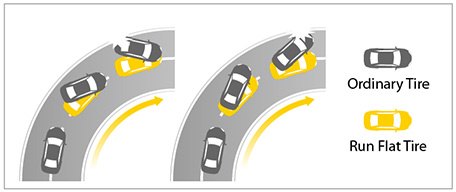
Run flat tires also known as safe tires or zero pressure tires are designed to perform after a puncture or complete loss of tire inflation pressure has occurred. These tires allow you to drive up to 80km at 80km/h to help you reach a safe place.
Comparison between Run Flat Tires and Ordinary Tires:

- How Do Tires Cope with Summer Heat?
-
 Challenge #1
 Challenge #2
Summer thunderstorms produce water on road surfaces and causes tire skidding.

- How Can Small Tires Carry Heavy Vehicles?
-

- A strong bead ring is found on the inner part of the tire, where the tire and rim join together. The bead ring securely fastens the tire with the rim to ensure safety and minimize deformation.
- When a partial amount of pressure is applied, the strong bead ring can withstand up to 3 tons before it detaches from the tire.
- It will take more than 6 tons of force to break the bead ring.
- How Do Valves Keep Tires Safe?
-
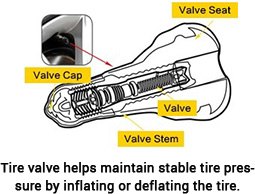
The tire valve may be small, but it is an extremely important vehicle component that helps improves safety and tire life. The valve also ensures stable tire pressure is attained by allowing you to adjust the pressure. A valve cap is an essential part of the valve that provides added protection and prevents dust from seeping in.
The tire valve is made of rubber and after long term usage it will deteriorate. Overtime, normal driving practices will exert pressure on the valve causing damage or wear. Although a tire valve is not expensive, it plays an important part in tire performance and safety.
Giti Tire recommends replacing tire valves whenever new tires are installed.
Tire valve helps maintain stable tire pressure by inflating or deflating the tire.
- How Do Tires Maintain Maximum Contact Area?
-

When traveling on the road, tires are the only part of the vehicle that comes into contact with the ground.

The contact area of each tire is equivalent to the size of a hand.

 Carrying a weight of
 - Do You Know the Importance of Maintaining Proper Tire Pressure?
-
Proper Tire Pressure Is Important.

- How to Avoid Safety Hazards When Driving?
-

Hazard #1: Exterior Tire Damage
Leads to: air leaks, flat tires, shorter tire life, and affects safe travels
 Carefully check your tire's appearance. If problems appear, replace the tires immediately.
 Hazard #2: Excessive Tread Wear
Leads to: reduced handling, braking, and water dispersion abilities
 Measure the tread depth. If less than 1.6 mm, replace the tires immediately.
 Hazard #3: Improper Tire Pressure
Leads to: uneven tire wear, reduced handling and comfort, increased fuel consumption, and even tire blowouts
 Check the air pressure of all tires (including the spare). Standard tire pressure recommendations can be found in the owner's manual or on the driver side car door.
 - How to Choose the Right Shoes for Your Vehicle?
-
When faced with complex road conditions, do you know how to choose the right tires for your car?
 Selecting Suitable Tires for Different Road Conditions is Essential!
Friction Generated By Tire Pattern and Ground Is a Source of Power for Tires
 Fine Tread Pattern (HT)
 Comfort Low Noise
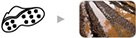 Exaggerated Tread Pattern (MT)
Strong Off-Road Capabilities
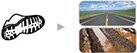 Balancing Off-Road Capabilities and Comfort
 - Do You Know how Many Rotations Your Tires Make Per Second?
-


- How to Examine Tire Wear?
-
Every tire is designed with a tread wear indicator (TWI) which is a raised section molded into the grooves of a tire. In passenger car tires, the TWI is around 1.6 mm and the tire shoulder is labeled with TWI or the triangle symbol.
TWI indicates the tread wear limit and helps vehicle owners understand the tread wear so they know when to replace the tires. When the tread is leveled with the TWI, the tread pattern will be separated and the tires need to be replaced immediately.
Note: When tread wear limit is reached, handling, braking, and water evacuation will significantly be decreased. Extremely dangerous!
Replace Tires Immediately If:
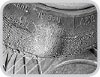 Please replace tires immediately to avoid tire blowouts
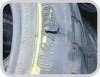 Increases probability of tire leak
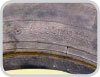 Tire shows signs of deterioration
If your tires have any of the conditions mentioned above, it is recommended that you visit the nearest Giti Professional Service Center to replace the tires!
- How to Read the Sidewall?
-
The sidewall of a tire contains information for your safety and knowledge. Being able to read sidewall markings will help you better understand the performance of each tire and provide information for mounting and servicing the tire.

Codes:
1. Section Width (mm) 2. Aspect Ratio 3. Rim Diameter (in) 4. Load Index 5. Speed Index

Passenger Car Tire Specifications:
(195/60R15 88V)
- 195: Section Width (mm)
- 60: Aspect Ratio
- R: Radial Construction
- 15: Rim Diameter (in)
- 88V: Load Index and Speed Rating
- What is Speed Rating? How Will a Lower Speed Rating Affect the Vehicle?
-
Under specified conditions, speed rating is a letter representing the maximum speed at which the tire can carry a load corresponding to its load index (except for passenger car and motorcycle tires with speeds greater than 210 km/h).
Under specified conditions, load index is a numerical code representing the maximum load the tire can carry corresponding to its speed rating (except for passenger car and motorcycle tires with speeds greater than 210 km/h).
Speed rating is represented with a letter from J to Z and is the maximum speed corresponding to its load index.
Please refer to the following speed rating table (Maximum Speed)
Symbol Max Speed (mp/h) Max Speed (km/h) J 62 100 K 68 110 L 75 120 M 81 130 N 87 140 P 93 150 Q 100 160 R 106 170 S 113 180 T 118 190 H 130 210 V 150 240 W 168 270 Y 188 300