
Information
- DINAN’S E9X M3 EXHAUST
-
By Steve Dinan
- After many months of development and far too many dyno-runs to count, brands Free Flow Exhaust for the E9x M3 is now shipping. I couldn’t be happier with the finished product as Dinans team of engineers was able to accomplish every goal I had established for the performance muffler: improved flow for increased power, reduction of weight, a “throaty” exhaust note and a purposeful high performance look. As Dinans M3 exhaust employs a unique design approach in order to accomplish Dinans objectives, I thought that a more technical discussion on the subject might be of interest to performance enthusiasts. This paper will discuss a bit of general exhaust theory, the specific approach Dinan has employed for the E9x M3 exhaust, as well as attempt to dispel some common misconceptions about exhaust tuning.
Exhaust Theory
- There are three major areas of the complete exhaust system that are typically tuned for enhanced performance; the exhaust manifold with catalyst or header, the middle exhaust section with catalyst, and the rear muffler(s). The exhaust manifold’s length, tubing diameter and the manner in which each cylinder is linked to the other is critical when attempting to maximize an engine’s power output. The manifold configuration can be manipulated in order to generate maximum power throughout the entire RPM range, changing the shape of the power curve accordingly. Naturally some compromise must be accepted when tuning an exhaust manifold for a street-car as the goal is typically to ensure balanced power output at low, middle and high rpm. This is in contrast to a race-engine where the exhaust manifold can be tuned specifically for maximum performance at high rpm.
- After the exhaust manifold or header, optimum performance comes from making the balance of the exhaust system as short and large as possible. This approach will result in greater engine efficiency for maximum power, as well as minimizing the weight of the system. Probably the best example of an optimized, no-compromise exhaust system would be that of an F1 racecar. If you have ever had the opportunity to hear a F1 exhaust note, I think you will agree that it is best described as deafening. Clearly an exhaust system that even approached such a volume level in a performance street-car would draw far too much of the wrong sort of attention. Therefore, a modern street-car exhaust represents a number of performance compromises in order to achieve an acceptable exhaust volume, as well as meeting emissions standards. In order to accommodate the various components and baffling necessary for a street-car, the exhaust system becomes longer and the flow of gasses more circuitous as noise and emissions standards are addressed. Each bend in the exhaust tubing, catalytic converter, resonator and so forth introduces restrictions to the exhaust flow, particularly at higher rpm where flow is most critical. Exhaust flow can actually reach hundreds of miles per hour when the engine is producing maximum power, which results in power robbing friction along the exhaust tubing walls, particularly when the gasses must change direction. This friction results in increased backpressure that can be quantified with a pressure gauge. This backpressure restricts the amount of gasses that can be passed through the engine, resulting in a reduction of peak power. I’m fairly certain that many of you have been exposed to a “bench racing legend” that would have you believe that increased backpressure will improve low rpm power and that low backpressure will increase high rpm output. Nothing could be further from the truth. An exhaust system is sized for maximum flow at wide-open-throttle and peak rpm. All exhaust systems are “oversized” for lower engine speeds (rpm), as backpressure is so insignificant that it can’t even be measured. Less backpressure always results in more power at higher rpm, with no negative effect on lower engine speed performance. The amount of power that can be extracted from an engine at a given rpm as a result of exhaust design is really limited by the exhaust manifold or header. After the header, less backpressure is always better. The real challenge when tuning a street-car exhaust is to increase flow without making the system loud or eliminating catalyst that will prevent you from registering your car because of your local emissions standards. It is also important to understand that vehicle manufacturers must meet more stringent maximum noise requirements than aftermarket manufacturers.
- Headers have become very popular in recent years because they make substantial power gains. The real reason they gain power has more to do with eliminating the front catalyst that is built into the header than the header itself. Modern M Cars have very high quality well tuned headers but to meet the emissions standards, there are four catalysts, two in the header and two more in the center exhaust section. The two three-way catalysts on the header are monitored by secondary O2 sensors to report catalyst efficiency to the ECU. There are two more catalysts mounted under the floor before the resonator and are not monitored by the O2 sensors for catalyst efficiency. The front catalysts mounted on the header are usually twice as restrictive as the rear catalysts and are as close to the engine as necessary to light off cold to improve exhaust emissions on cold start.
- Moving on to the rear exhaust or mufflers, BMW’s current M-cars feature a distinctive quad exhaust tip design, punctuating the car’s high performance image. This approach is very logical when applied to a “V” engine configuration because there are natural dual exhaust outputs with this engine design, as indicated in the following diagram.
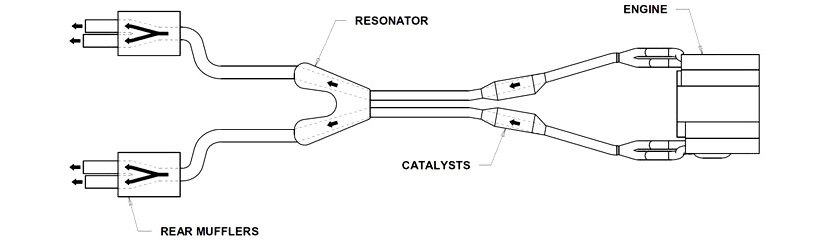 M5 EXHAUST
Rear Exhaust Design Approach
- When it comes to the E90-92 M3 muffler, however, the vehicle design did not lend itself to the more traditional twin muffler approach, necessitating a cross-over within the single muffler case in order to feed the four tips and reduce noise to an acceptable level. This design requires that the exhaust flow has two 90 degree bends in each side plus a “Y” pipe on each side to go from one input pipe to two tailpipes per side. These turns and “Y” pipes as indicated in the following diagram, increase back pressure.
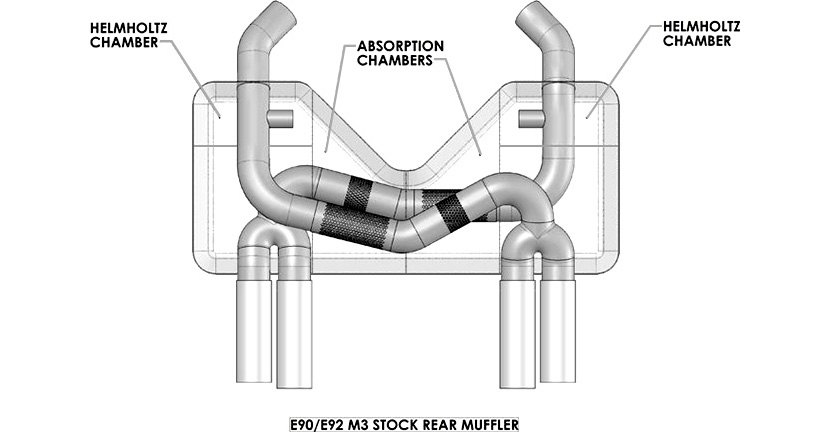
- Months of testing demonstrated conclusively, that requiring exhaust gasses to make four 90 degree turns within the stock muffler’s internal chamber results in a increase in back-pressure. The stock exhaust also incorporates a Helmholtz chamber within the muffler to tune low frequency drone out of the exhaust. During development it became obvious that the Helmholtz chamber would be necessary to maintain reasonable noise levels. In addition the “Y” pipe at the tail-pipe amplified the low frequency drone when compared to a single straight pipe.
- Because of power robbing turns and weight it was decided the mufflers needed to be straight trough with no bends or turns within the muffler case. Also because of low frequency drone it would also be necessary to incorporate a Helmholtz chamber within the exhaust. With this combination Dinan had power, light weight, reduced noise and low cost. All the things you are looking for in a high performance exhaust. However once Dinan incorporated a “Y” pipe at the tail pipe like the original BMW design to make quad exhaust tips the low frequency drone came back. It was possible to make the drone go away with the 4 – 90 degree turns like BMW used but Dinan lost significant power with a large increase in weight and cost. Or it was possible to get good flow and a low frequency drone with 4 tailpipe tips, but it was impossible to get both. Dinan considered using an external Helmholtz chamber like some companies have done. But this added additional weight and cost and was deemed unacceptable. Analyzing other after-market manufacturer’s mufflers revealed that they had all made a compromise because of these problems. Either they had high backpressure from keeping the BMW design or very loud low frequency drone with straight through twin muffler designs or heavy expensive exhausts with straight through designs and external Helmholtz chambers. Despite mounting pressure from M3 owners to deliver the Dinan® exhaust, Dinan made a conscious decision to continue working toward a design that accomplished Dinans stated objectives. While Dinan certainly would have preferred to begin shipping the systems sooner, I simply won’t accept compromises when it comes to performance.
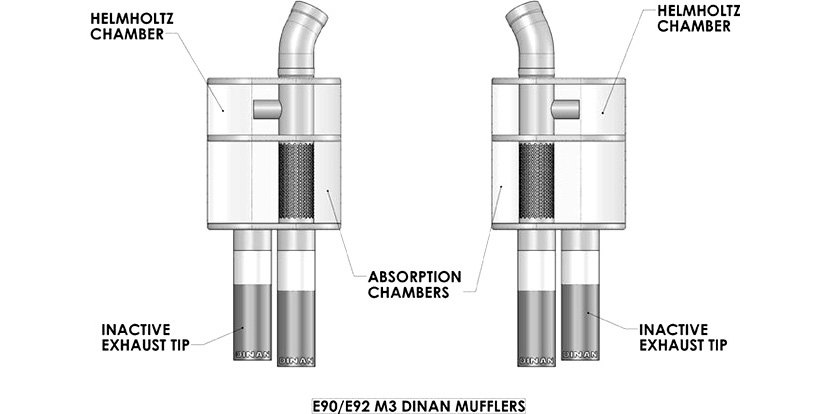
- Dinan worked and worked at designs that would maintain the dual exhaust outlets but each iteration resulted in a heavy, low frequency drone with far too much back-pressure to produce any substantial power gains. After analyzing many designs, Dinan came to the conclusion that a more radical approach was required in order to produce a truly high performance exhaust. Further pressure tests and dyno runs confirmed Dinans suspicions about the best approach for the M3 muffler. Adopting a completely new design approach resulted in a significant improvement in flow. The exhaust note became throaty and aggressive, without being loud. Weight was reduced from 56 to 41 lbs. As you can see from the diagram below, Dinans M3 exhaust utilizes the one active outlet per side. Recognizing that the four tips have become a significant visual design element for modern M-cars, as well as the fact that the rear valance has a cut out to accommodate four tips, both sides have a second tip that is inactive. While they are non-functional, the M-car look is retained without compromising performance. The 3? tips have been ceramic coated black for a striking high performance look, while eliminating any concern over uneven discoloration that would occur with polished stainless.
- The system produces measurable power gains, looks great, is light weight, low cost and produces the exhaust note M3 owners have been waiting for. I believe that this latest exhaust design underscores the importance of real engineering and extensive testing. The end result is BMW-like fit and finish combined with the best warranty in the business, and makes for the definitive solution for your high performance M3 exhaust.
- THE DANGERS OF POWER PULLEYS AND UNDERSTANDING HARMONIC DAMPER
-
by: Steve Dinan
- I have been threatening for a long time to write a series of technical articles to educate consumers and to dispel misconceptions that exist about automotive after-market technology. Motivated by problems with customers cars resulting from the installation of power pulleys, I wish to explain the potential dangers of these products and address the damage they cause to engines.
- The theory behind the power pulley is that a reduction in the speed of the accessory drive will minimize the parasitic losses that rob power from the engine. Parasitic power losses are a result of the energy that the engine uses to turn accessory components such as the alternator and water pump, instead of producing power for acceleration. In an attempt to minimize this energy loss, many companies claim to produce additional power by removing the harmonic damper and replacing it with a lightweight assembly. While a small power gain can be realized, there are a significant number of potential problems associated with this modification, some that are small and one which is particularly large and damaging!
- The popular method for making power pulleys on E36 engines is by removing the harmonic damper and replacing it with a lightweight alloy assembly. This is a very dangerous product because this damper is essential to the longevity of an engine. The substitution of this part often results in severe engine damage.
It is also important to understand that while the engine in a BMW is designed by a team of qualified engineers, these power pulleys are created and installed by people who do not understand some very important principles of physics. I would first like to give a brief explanation of these principles which are critical to the proper operation of an engine.
1) Elastic Deformation
- Though it is common belief that large steel parts such as crankshafts are rigid and inflexible, this is not true. When a force acts on a crank it bends, flexes and twists just as a rubber band would. While this movement is often very small, it can have a significant impact on how an engine functions.
2) Natural Frequency
- All objects have a natural frequency that they resonate (vibrate) at when struck with a hammer. An everyday example of this is a tuning fork. The sound that a particular fork makes is directly related to the frequency that it is vibrating at. This is its "natural frequency," that is dictated by the size, shape and material of the instrument. Just like a tuning fork, a crankshaft has a natural frequency that it vibrates at when struck. An important aspect of this principle is that when an object is exposed to a heavily amplified order of its own natural frequency, it will begin to resonate with increasing vigor until it vibrates itself to pieces (fatigue failure).
3) Fatigue Failure
- Fatigue failure is when a material, metal in this case, breaks from repeated twisting or bending. A paper clip makes a great example. Take a paper clip and flex it back and forth 90° or so. After about 10 oscillations the paper clip will break of fatigue failure.
- The explanation of the destructive nature of power pulleys begins with the two basic balance and vibration modes in an internal combustion engine. It is of great importance that these modes are understood as being separate and distinct.
- The vibration of the engine and its rigid components caused by the imbalance of the rotating and reciprocating parts. This is why they have counterweights on the crankshaft to offset the mass of the piston and rod as well as the reason for balancing the components in the engine.
- The vibration of the engine components due to their individual elastic deformations. These deformations are a result of the periodic combustion impulses that create torsional forces on the crankshaft and camshaft. These torques excite the shafts into sequential orders of vibration, and lateral oscillation. Engine vibration of this sort is counteracted by the harmonic damper and is the primary subject of this paper.
Torsional Vibration (Natural Frequency)
- Every time a cylinder fires, the force twists the crankshaft. When the cylinder stops firing the force ceases to act and the crankshaft starts to return to the untwisted position. However, the crankshaft will overshoot and begin to twist in the opposite direction, and then back again. Though this back-and-forth twisting motion decays over a number of repetitions due to internal friction, the frequency of vibration remains unique to the particular crankshaft.
- This motion is complicated in the case of a crankshaft because the amplitude of the vibration varies along the shaft. The crankshaft will experience torsional vibrations of the greatest amplitude at the point furthest from the flywheel or load.
Harmonic (sine wave) Torque Curves
- Each time a cylinder fires, force is translated through the piston and the connecting rod to the crankshaft pin. This force is then applied tangentially to, and causes the rotation of the crankshaft.
- The sequence of forces that the crankshaft is subjected to is commonly organized into variable tangential torque curves that in turn can be resolved into either a constant mean torque curve or an infinite number of sine wave torque curves. These curves, known as harmonics, follow orders that depend on the number of complete vibrations (cylinder pulses) per revolution. Accordingly, the tangential crankshaft torque is comprised of many harmonics of varying amplitudes and frequencies. This is where the name "harmonic damper" originates.
Critical RPMs
- When the crankshaft is revolving at an RPM such that the torque frequency, or one of the harmonic sine wave frequencies coincides with the natural frequency of the shaft, resonance occurs. Thus, the crankshaft RPM at which this resonance occurs is known a critical speed. A modern automobile engine will commonly pass through multiple critical speeds over the range of its possible RPMs. These speeds are categorized into either major or minor critical RPMs.
Major and Minor Critical RPM’s
- Major and minor critical RPMs are different due to the fact that some harmonics assist one another in producing large vibrations, whereas other harmonics cancel each other out. Hence, the important critical RPM’s have harmonics that build on one another to amplify the torsional motion of the crankshaft. These critical RPM’s are know as the "major criticals". Conversely, the "minor criticals" exist at RPMs that tend to cancel and damp the oscillations of the crankshaft.
- If the RPM remains at or near one of the major criticals for any length of time, fatigue failure of the crankshaft is probable. Major critical RPM’s are dangerous, and either must be avoided or properly damped. Additionally, smaller but still serious problems can result from an undamped crankshaft. The oscillation of the crankshaft at a major critical speed will commonly sheer the front crank pulley and the flywheel from the crankshaft. I have witnessed front pulley hub keys being sheered, flywheels coming loose, and clutch covers coming apart. These failures have often required crankshaft and/or gearbox replacement.
Harmonic Dampers
- Crankshaft failure can be prevented by mounting some form of vibration damper at the front end of the crankshaft that is capable of absorbing and dissipating the majority of the vibratory energy. Once absorbed by the damper the energy is released in the form of heat, making adequate cooling a necessity. This heat dissipation was visibly essential in Tom Milners PTG racing M3 which channeled air from the brake ducts to the harmonic damper, in order to keep the damper at optimal operating temperatures. While there are various types of torsional vibration dampers, BMW engines are primarily designed with "tuned rubber" dampers.
- It is also important to note that while the large springs of a dual mass flywheel absorb some of the torsional impulses conveyed to the crankshaft, they are not harmonic dampers, and are only responsible for a small reduction in vibration.
- In addition to the crankshaft issue, other problems can result from slowing down the accessories below their designed speeds, particularly at idle. Slowing the alternator down can result in reduced charging of the battery, dimming of the lights, and computer malfunctions. Slowing of the water pump and fan can result in warm running, while slowing of the power steering can cause stiff steering at idle and groaning noises. It is possible to implement design corrections and avoid these scenarios, but this would require additional components and/or software.
- Their motto at Dinan is "Performance without sacrifice" They feel their customers expect ultra high performance along with the legendary comfort and reliability of a standard BMW.
- While it is common that a Dinan BMW is the fastest BMW you can buy, performance is not their only goal. Dinan isnt just trying to make the fastest car. Instead a host of considerations go into the development of their products. Dinan puts much more effort into these other areas than does their competition.
These considerations are Performance, Reliability (Warranty), Driveability, Emissions, Value, Fit and Finish. They feel that the power pulley is a bad way to get extra power from and engine and the potential for serious engine damage is too great.
- This is a simplified explanation meant to be comprehensible by those who are not automotive engineers. In trying to simplify an extremely complex topic some precision was sacrificed although they believe this explanation to be as accurate as possible. They encourage their customers to educate themselves and understand the automotive after-market because they believe that their products are the best researched, engineered, and fabricated products available.
- For those interested in a more in depth and technical explanation of this topic, the reference book is Advanced Engine Technology, written by Heinz Heisler MSc,BSc,FIMI,MIRTE,MCIT. Heinz Heisler is the Head of Transportation Studies at The College of North West London. His book is distributed in this country by the SAE (Society of Automotive Engineers).
- SOFTWARE ENGINEERING AND TUNING
-
DISPELLING PERFORMANCE SOFTWARE MYTHS
By Steve Dinan
- BMW enthusiasts may have noticed that Dinan® Performance Software released for sale in recent years has been developed in combination with a replacement high-flow air filter element and or removal of the Air Filter, Hydrocarbon Absorber. The reason for this approach is actually quite simple: the revised software calibrations in combination with the additional air-flow provided by a superior flowing filter or air box provides greater gains, and therefore represents an even better performance value. Naturally Dinan software continues to offer additional performance benefits beyond just horsepower and torque gains, such as a higher rev-limit, no top speed governor and improved throttle response. Of course Dinan software is installed as it was meant to be, directly through the factory OBD II connector, no trivial accomplishment from an R&D standpoint but clearly the most elegant approach. Communication with BMW ECUs has become very challenging, explaining why you see almost every other software tuner requiring you to send your ECU to them for bench-programming instead of being able to load it through the OBD II connector. (no “down time” for the car itself).
- Engine management systems have gotten so sophisticated and the knock-control systems so effective that the power gains achievable from software alone are often relatively small with modern BMW models. Basically, the engines are tuned by the factory to produce nearly optimum power based upon the fuel being used and other factors, leaving less power “on the table” for tuners to extract. Having said this, They’re seeing some pretty “optimistic” or perhaps more accurately “exaggerated” power gain claims in the market. As an example, I’ve seen as much as a 25-hp gain claimed on the new M5 from software tuning alone! While Dinans research has clearly indicated that there isn’t that much power to be made, Dinan has purchased Dinans competitors’ software and evaluated it on the dyno, employing time-tested procedures and state of the art equipment. Dinan has yet to measure anywhere near the claimed power gains and in fact Dinan is typically seeing about half of what is being published, even with the removal of the Hydrocarbon Absorber.
- Dinans competitors often claim that Dinan® is “backing off” on potential power gains for emissions or warranty reasons, or even because BMW is influencing how aggressive Dinan can be. Nothing could be further from the truth; Theye’re simply providing the BMW enthusiast with scientifically valid dyno results. I’m more than a little proud to say with confidence that Dinan has the largest R&D department of any BMW aftermarket tuner in the US, state of the art equipment, years of knowledge and experience. They’re providing the BMW owner with every bit of power possible from engine management tuning and certainly not “backing off” for any reason. Dinans published horsepower and torque gains represent real, measurable gains, based upon SAE standard J1349.
- Dinan will often recommends a high flow air filter. In the case of the M5, no filter replacement is suggested because Dinans tests revealed no measurable increase in power over the stock filter. However, the removal of the Hydrocarbon Absorbers, which have been demonstrated to restrict air-flow, does enable the Dinan® software to be more effective, much like a replacement air filter would for other models. In both cases more air is flowing, and the Dinan software is tuned for it, maximizing power output.
- They’ve talked a bit about software tuning, along with some extra air-flow from less restrictive filters. A logical question, then would be what about specific software tuning for other modifications that might be applied to the cars. Modern BMW engines are so sensitive to accurate tuning and setting faults that in almost every case a specific version of software designed for use with an engine modification will result in not only greater power gains but reduced potential for malfunctions as well. The more extensive the modifications, the more important specific software for those modifications becomes. I’ve had customers tell me that there is no point in tuning a new BMW because there is no power to be gained due to the fact that the cars are tuned so well from the factory. Fortunately for enthusiasts, this has not been Dinans experience at all. With the possible exception of software, they are seeing substantial gains, as large or even larger in some areas than they have realized from older BMW models. Having said that, the high performance products themselves require far greater investment in research, testing and refinement. As you might imagine, it is far more expensive to develop and produce premium quality performance products today than it has ever been. If you spend the necessary time to research the vehicle’s inherent weaknesses and effectively address them, the power gains can be very significant. Using the M5 as an example once again, the intake system they are developing for the V-10 is producing an additional 20-25 hp with matching software tuning. This will represent one of the largest power gains they have achieved with this type of product to date.
- In addition to conventional power-tuning such as calibration of fuel mixture, ignition timing, cam timing and torque limiters, Dinan® software offers additional value as discussed earlier. Removal of the top speed governor enables the driver to achieve the vehicle’s natural top speed (under the proper conditions, of course). The increased rev-limit improves acceleration times and allows for optimized shift points. Drive by Wire programming improves throttle response, making the car more responsive. In addition, when the car is modified with other performance products, Dinan software is tuned for sensor transfer function and fault diagnostic functions, reducing the potential of check engine lights and ensuring BMW-like drivability. The new BMW control units are very sophisticated and time consuming to understand properly but the results of these efforts are well worth the investment.
- Earlier in this discussion I mentioned the challenge presented by communication issues with the modern ECUs. Dinan® has successfully worked through these communication issues with most BMW models and they can now load software through the OBD II connector on the new (E60) M5, 550, 545, and (E63/64) M6, 645, 650, as well as the X5 and all of the 6 cylinder 3.0 and 2.5 liter engines found in the 330, Z4, X3, X5, and 5 series from March 2003 through 2005. That is not to say that future models won’t need to be sent to Dinan for programming on the bench but Dinans engineers are hard at work to avoid this approach, at the very least minimizing the number of ECUs that need to be handled in this manner.
- As you can imagine, these challenges and complications have caused software to take longer to get to market along with a sharp increase in the cost of software development and the resulting retail prices in recent years. I have seen prices from $1,500 to $3,000 for (E60) M5 software! Very high indeed, especially if you factor in a realistic power gain claim. However, considering the cost of developing software for the new cars and how important it is to a properly running performance modified BMW, it doesn’t seem like enough! Dinan® has invested literally millions of dollars in recent years on software development and while it was once a significant profit center for them, they now actually lose money on this part of Dinans business when you factor in the exorbitant R&D costs. Regardless, they feel software is very important and absolutely necessary in order for them to bring you the best running, most reliable performance products possible, and at a reasonable price. Even with our matching 4 year/50,000 mile warranty, the absolute best guarantee in the business, and the solid engineering behind the product, Dinan’s M5 software is the least expensive currently available.
- In the future, things will only become more complex and therefore more challenging from an R & D standpoint. The software will take longer to develop, it will cost more and the reality is that it will likely produce smaller power gains. At the same time, software tuning will become even more important when modifying your car with performance hardware! The one notable exception to this is cars equipped from the factory with turbo systems. Since the turbo boost control is accomplished with software, relatively large power gains can be achieved with software alone. With proper software tuning, the boost can be increased on the 335, for example, to produce an honest 40-50 hp gain. It should be noted that there is significantly less exaggeration by tuners producing software for turbocharged cars because the gains are significant.
- “Piggy-back” control units will also become more popular as access to the ECUs and the software inside becomes more difficult. The naturally aspirated engines will produce more modest power gains, just as with software. However, with turbos in particular, significant gains can be achieved with piggy-back control units. Having said that, piggy-back units simply cannot make as much power as properly tuned software, regardless of the claims being made by companies selling control units for the 335. Additional important features such as rev-limit increases and speed governor removal are very difficult and usually not offered with a piggy-back control unit. More faults and frankly compromised reliability will also result from these control units when compared to good software. This is because it is more difficult to obtain correct sensor, fuel mixtures and ignition timing values without getting a fault. In addition, computer controlled turbos have safety features that lower boost and re-tune the mixture and timing based on heat exchanger efficiency, engine temperature and detonation. Often piggy-back control units will compromise these safety programs because they “fight” these corrections rather than implement them as would be the case with properly engineered software.
- At the risk of being blunt, it is important to realize that not all software available out there is calibrated correctly. When they looked at some of the M5 software on the market for example, they found a significant number of calibration errors. Sure it takes longer to develop a well-engineered and thoroughly tested product. In addition, the method by which the software is installed is also an important and challenging aspect. While it has certainly taken them longer to get Dinans software to market than some of Dinans competitors, their product improves the performance of the M5 in many ways, including additional horsepower and torque, and it can be installed at your local Authorized Dinan® Dealer, eliminating the need for owners to remove their ECU in order to send it somewhere for modification, creating days of downtime. Clearly the Dinan approach is far more convenient.
- DYNAMOMETER TESTING AND THE MODERN BMW ENGINE
-
DYNAMOMETER TESTING AND THE MODERN BMW ENGINE
By Steve Dinan
- As dyno-testing facilities have become more and more abundant in recent years, increasing numbers of driving enthusiasts appear to be having their BMWs tested. While dyno equipment has become more sophisticated over the years, there still is no substitute for scientific testing procedures and a deep understanding of the factors that will affect the data obtained. No matter how well a dynamometer is designed, manufactured and supported, the information obtained may be meaningless, or at least misleading, if the operator does not have a clear understanding of the procedures necessary to duplicate “real world” conditions and the associated variables. Given the growing number of questions Dinan receives regarding the results drivers are getting from independent tests, not to mention the inconsistencies, I thought that a bit of a technical discussion on the subject might be of interest to BMW enthusiasts.
- A modern BMW engine management system is very sophisticated and has the ability to correct for changes in environmental conditions as well as fuel quality. If Dinan goes back fifteen years, engine control systems were not nearly so advanced and so power output was backed off from an engine’s full potential in order to ensure longevity. Now that engine control systems have advanced so dramatically, manufacturers can better manage conditions that might otherwise result in engine failure and they can produce more power per cc than ever before. While maximum horsepower has increased, so too has the variability of power output. This is because the engine control systems save the engine from failure by backing off power when conditions are less than ideal. This variability comes from the control system striving to extract whatever power is available, under a given set of conditions.
- As you would expect, all of Dinans engine tuning products are dyno tested and the results published as part of Dinans product descriptions. I’ll be the first to admit that Dinan’s dyno-numbers typically represent the lower of any claimed horsepower and torque increases for a given product type in the market. And in the case of performance engine management software for later model cars, Dinan seem to be the only BMW tuner that has come to grips with the fact that there is simply no horsepower to be gained from engine management tuning alone. Even when it comes to performance engine components such as Cold Air Intakes, Super-chargers, exhaust systems and the like, Dinan’s published performance data is often lower than that claimed by Dinans competitors. Does this mean that Dinan® products fall short when it comes to horsepower gains? Hardly. Dinan is committed to providing the enthusiast with valid test data that is based upon the results of the very latest equipment, controlled testing procedures and years of experience. Dinans reputation among automotive journalists as the American BMW tuner that consistently provides realistic and verifiable performance data has been earned by exceeding expectations for nearly 25 years. My philosophy has always been to under-promise and over-deliver, despite whatever shall Dinan sais “optimistic” gains are being touted by the competition.
- Please don’t get me wrong, I’m not suggesting that Dinans competitors or the many dyno testing facilities are intentionally misleading driving enthusiasts by publishing false or exaggerated data. There are tuners that have an understanding of what needs to be done in order to obtain accurate data. I am of the opinion that even the tuners that publish questionable results are actually publishing numbers that reflect the very data that was obtained during their tests. The disparity lies in the dyno testing procedures employed and perhaps a lack of understanding with regard to the variables that can affect the data obtained. A prime example would be the fact that Dinan gets reports from customers who have obtained independent dyno results that range from more, to less, to no gain at all when compared to Dinans published data.
- Does this mean that most of the test data is invalid? Unfortunately, in most cases the answer is yes. I believe that this underscores the importance of controlling variables that can directly affect the results, as well as the importance of testing and re-testing in order to obtain a valid average. Truly scientific dyno tests are extremely time consuming, tedious and complex to perform when attempting to duplicate real world conditions in the dyno-room. I offer the following information in an effort to explain a bit about the equipment and the procedures Dinan has developed over the past 25 years of BMW performance tuning, perhaps shedding a bit of light on the subject in general terms.
About Dynamometers
- By far the most common types of chassis dynamometers employ large rollers that are turned by the vehicle’s drive wheels. When Dinan relied on this type of equipment, Dinan would replace the stock rubber with sticky, shaved tires in order to reduce slippage on the rollers. The rear wheels would also be set at maximum positive camber, further improving traction on the dyno rollers. The cars would then be tied down with four steel cables in order to further reduce slippage and provide increased safety. Two of the cables were focused on down-force in order to increase traction and the others positioned to hold the car in place on the rollers. In order to accurately read power output, cable tension was evaluated and adjusted in order to ensure that the tension was not too light, causing an artificially low reading due to slippage and that there was not so much tension that drag would negatively affect the readings. All tires slip to some degree, more so as power increases, therefore it is impossible to measure 100% of any gains that are achieved with this type of equipment. Accuracy can be improved with a roller type dyno by connecting a tachometer to the rollers and wheels, or a strobe light with markings so that the measured output may be adjusted accordingly.
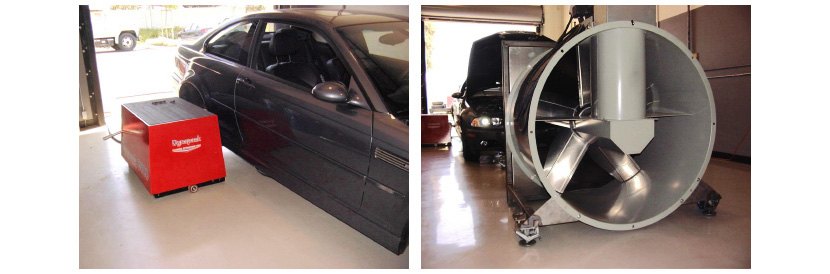
- Employing the very latest in chassis dyno technology, Dinans current equipment eliminates the tire slippage issue as it connects directly to the drive wheel axles. By eliminating the tires and any related slippage, the results are far more accurate and repeatable, making this type of dyno superior in my opinion.
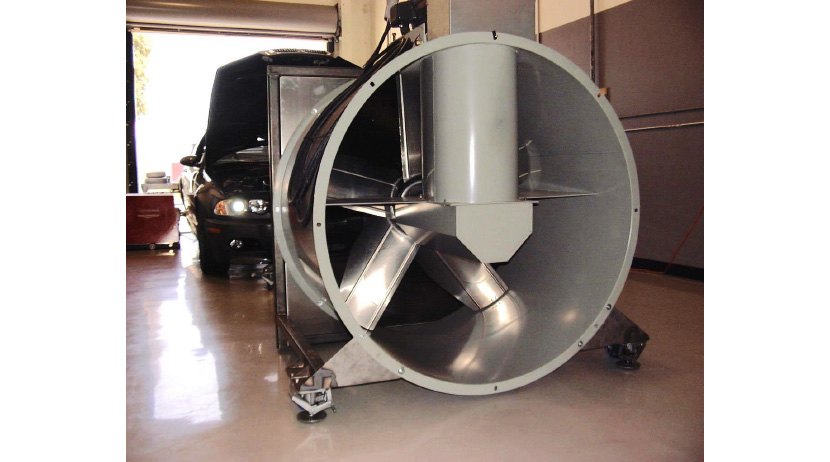
- By far the most significant criticism I have for many dyno facilities is the use of fans that are simply too small for the job at hand. The fan size is so significant that Dinan employs a very large unit that was actually designed for ventilation systems installed in high rise buildings! This powerful fan produces 38,000 cfm of air flow @ 75 MPH, which is still less than the 150 MPH air that a modern BMW might see at redline in 5th gear, but it certainly provides a closer to real-world scenario than the more common fans I have seen used in dyno facilities. It should be noted that 5th gear is used for Dinans dyno testing because it is one to one, meaning that the input and output shafts are connected, reducing power losses and transmission wear. I have seen many examples of dyno facilities where low flow fans obtained from the local hardware store are employed, and even situations where there was no fan at all. A minimum of 15,000 cfm and preferably 40,000 cfm of air flow is required for proper heat exchanging. This type of fan will produce a 40-80 mph air discharge velocity.
- A lack of air-flow during dyno testing will almost always alter the fuel mixture in the rich direction as the radiator cannot exchange enough heat, resulting in the computer compensating by retarding timing and richening the fuel mixture to prevent the engine from overheating and detonating. In addition, the intake air sensor will read substantially higher temperatures than that seen on the road with proper airflow. This issue is particularly important to address when testing high output cars like the M5 or M3, and even more so on forced induction cars with intercoolers as the heat exchanger is not able to cool as efficiently because of the reduced air flow. The engine compartment is normally flushed with air driving down the road, particularly at speed, cooling the manifolds and other associated engine components. Cooler engine components and lower air intake temperatures will result in a leaner air/fuel mixture and ignition timing will be advanced, invariably resulting in greater power on the road than on the dyno. In simpler terms, accurate measurements can only be achieved when the dyno tests are conducted in a manner that simulates the car driving down the road, in as much as is possible.I believe that the rather large horsepower gains that are being published by some, particularly with regard to “power chips”, are the result of tuning the cars back to the stock mixture and ignition timing settings, essentially leaning-out the air/fuel mixture and advancing the timing to compensate for the rich mixture and retarded timing experienced on the dyno. It appears to me that this “increase” in power is then included in whatever gains were actually achieved (if any). In reality, these supposed gains are nothing more than a correction for the testing conditions, resulting in an exaggerated performance claim. In addition, many “power chips” create the perception of an increase in power/acceleration as the re-programming will often dramatically increase the speed of the throttle opening on the drive by wire cars, making the engine feel more powerful.Dyno Testing Variables and How to Reduce Them The procedures that Dinan has developed are the result of many years of experience, extensive research and a very real desire to obtain the most accurate data possible. Following is a relatively detailed description of the variables and what Dinan does to reduce the impact on dyno results.Testing the Dinan® S2-M5 The first step is to prepare the vehicle for a “baseline” run. The 91-octane premium pump fuel (the highest octane currently available in California) is replaced with 93-octane fuel, as it is the most common premium pump fuel available in the U.S. In order to ensure that the vehicle being tested is a representative sample, it is inspected for any defects that might affect performance, including tests related to oil consumption, leak down. In the event that a defect is discovered, the car is then repaired accordingly or in some cases even rejected for such testing. The last thing Dinan wants to do is test and tune a car exhibiting any sort of issue that might negatively affect the car’s performance in stock or modified form.
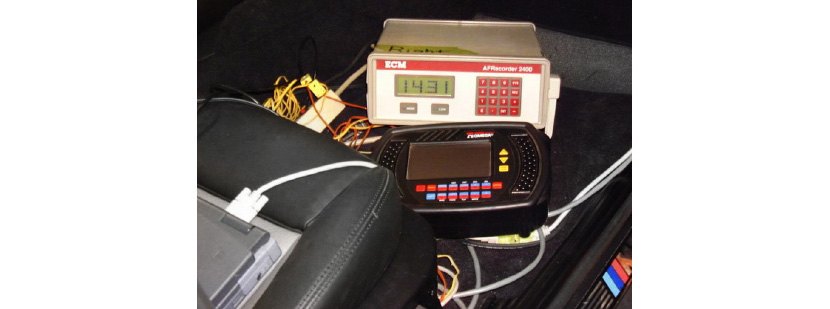
- Before Dinan places a car on the dyno, Dinan installs sophisticated data collection equipment that has been designed to measure the air/fuel mixture, ignition timing the engine’s air intake temperature; the engine block and radiator coolant temperatures; as well as the engine, transmission and differential oil temperatures. These measurements are conducted on the road, under normal driving conditions and are only recorded once the temperatures have stabilized at what would be considered normal operating temperature. Once the temperatures are stabilized, Dinan records the data from 2,000 rpm to redline at wide- open throttle. Again, the data is collected with the transmission in the gear that is one to one, typically 5th, so that the input and output shafts are connected, reducing power losses and wear on the transmission. The data is recorded several times in order to obtain a solid average.
Sample Data Aquisition Display
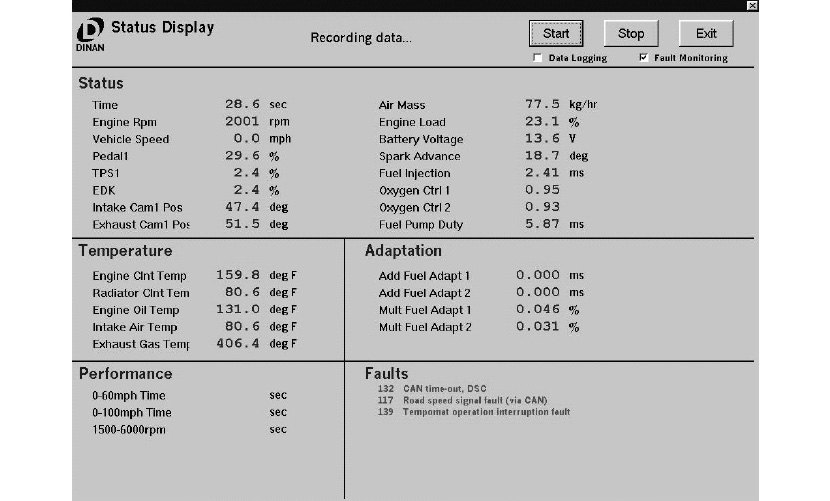
- Next, the times necessary for the stock car to achieve various speeds are recorded on the road and then loaded into the dyno program in order to simulate road conditions.
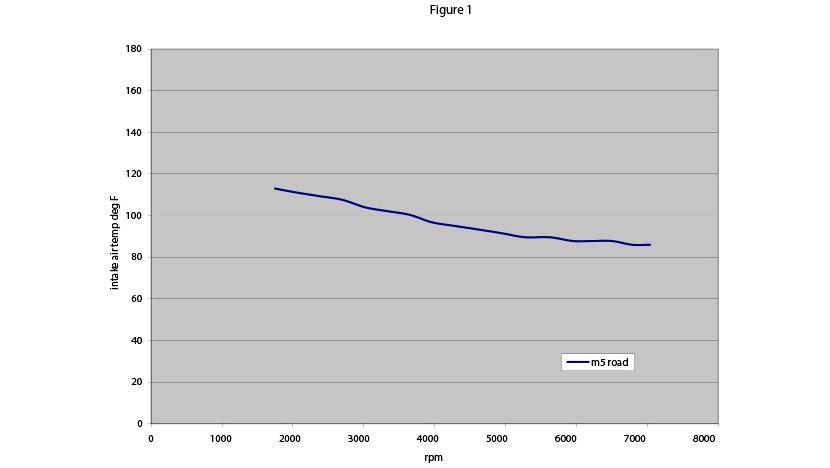
- The air intake sensor is located under the hood of the E39 M5, absorbing heat produced by the engine. As you can see in Figure 1 below, on the road the sensor absorbs heat from the engine, artificially raising the reading the computer sees to 110° F. As soon as you accelerate at wide open throttle, the ram air coming into the engine flushes out the hot air and cools the sensor. By the time the engine reaches high rpm the temperature sensors are seeing 85°, very close the 80° F ambient temperature that was recorded during the test run.
Figure #1: E39 M5 Intake Air Temperature Measured on the Road
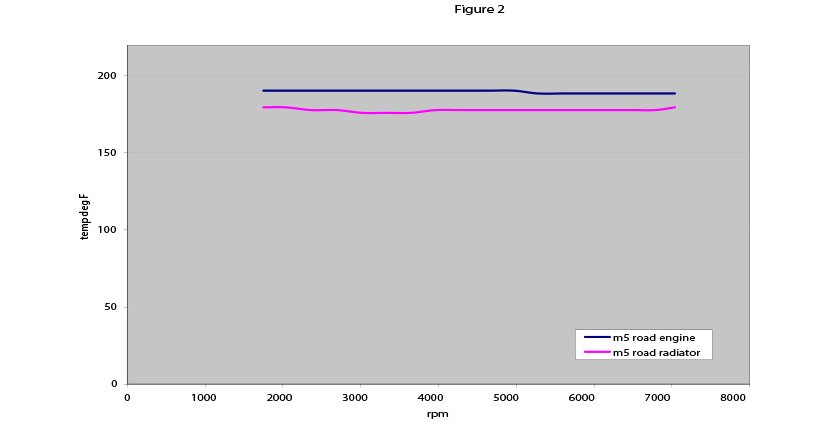
- Referring now to the stock radiator and engine block temperature graph below (Figure 2), you can see that BMW’s engineers did an excellent job of maintaining consistent temperatures in both the radiator and block. As the engine revs friction is increased, as well as load and cylinder cycles. All three of these things produce more heat but as the engine revs, the car is moving through the air faster which rams more air through the radiator, exchanging additional heat and therefore maintaining a very stable temperature.
Figure #2: E39 M5 Engine and Radiator Temperatures Measured on the Road
- As you will soon see, once Dinan put the vehicle in the stagnant air in the dyno room, all of this changes. The first dyno run Dinan will talk about (Figure 3A – purple line) represents what I would consider the worst dyno testing procedure I have ever seen. The vehicle was placed on the dyno with the hood closed and a small fan positioned in front of the grille, typical of the fans I have seen in most chassis-dyno facilities. The engine is warmed up to normal operating temperature by performing two passes and then the car is left to idle for 10 minutes.
Figure #3A: E39 M5 Dyno Graph
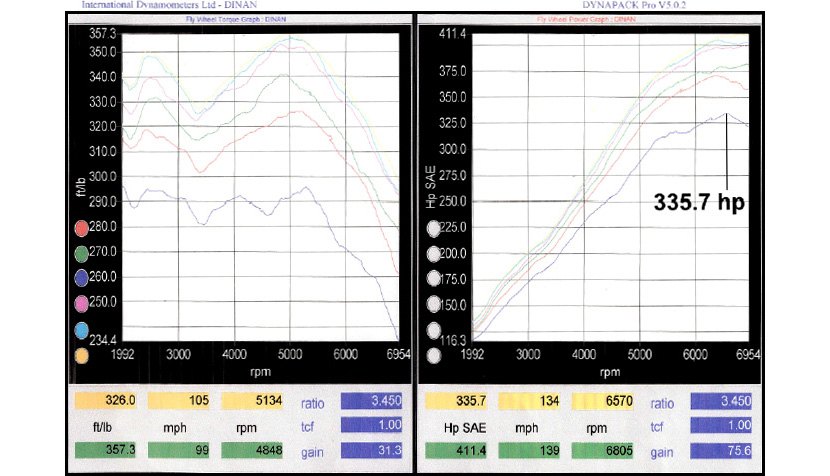
- This combination of conditions resulted in the lowest recorded output on the graph, producing 335.7 hp. During the two warm up passes the engine, radiator, intake manifolds, and air intake sensor will “heat soak”, resulting in a reduction of power. Let’s take a moment to look at each graph separately and analyze what has happened.
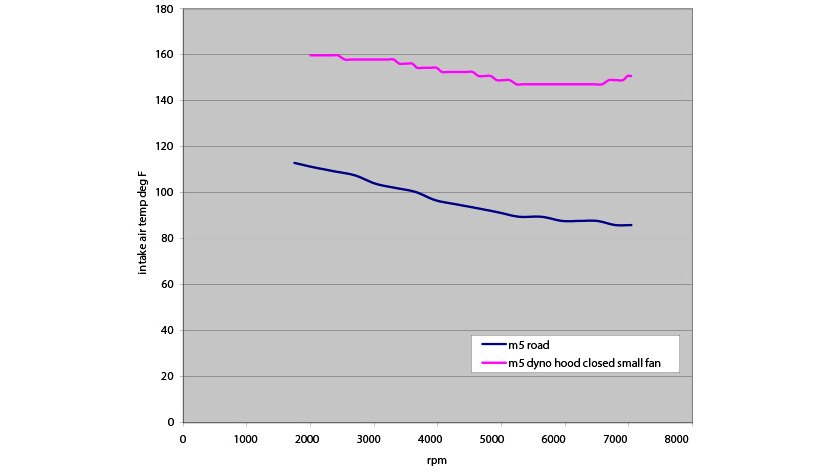
- When the M5 was on the dyno with the hood closed, and there was no ram air or air flowing under the car to evacuate heat from the engine compartment, the under-hood temperature rose significantly beyond what would be seen under normal driving conditions. As you can see in Figure 4 – pink line, the temperature reached 160° F from idling and even after the wide open throttle run was completed the temperature only dropped to 148° F! Comparing this to the road graph (Figure 4-blue line) shows a staggering increase in the temperature reading even though the outside air temperature has not changed at all. Normally when the computer sees a higher air temperature reading, it leans the air/fuel mixture and retards ignition timing in small amounts to compensate for the less dense air. This occurs in order to maintain a proper air/fuel mixture and prevent detonation. However, when the M5 computer sees a very hot value it goes into a portion of the program designed to save the engine from melt down. This mode dramatically richens the mixture and retards the timing, preventing engine damage in two ways: it causes the engine to produce less power, thereby producing less heat; and some of the heat is actually absorbed by the fuel, then carried out through the exhaust. In addition, the rich mixture and retarded timing ensures that the engine will not detonate under these conditions.
Figure #4: Intake Air Temperature Sensor Comparison
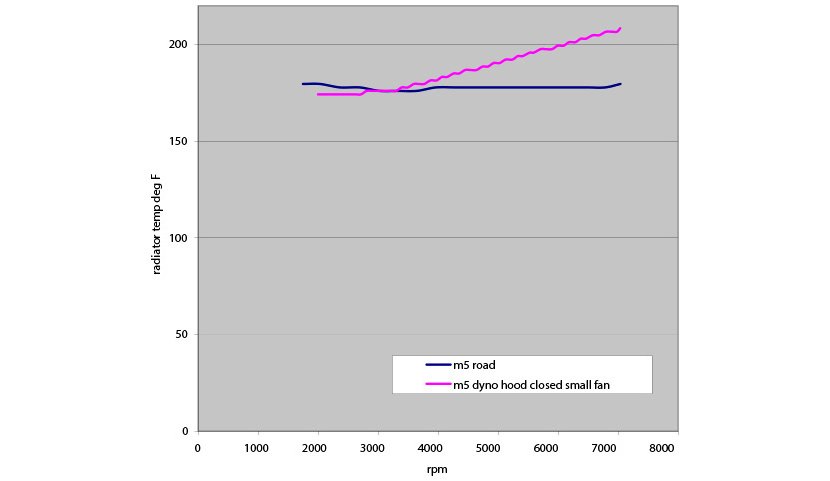
- The radiator cannot exchange heat as well as it did on the road because there is not enough ram air flowing through it. Looking back at the road temperatures depicted in Figure 5 – blue line, Dinan can see that the radiator stays between 175° F and 178° F. Now compare those readings to the radiator temperature from the dyno acceleration run in Figure 5 – violet line. With the standard dyno fan you can see that the temperature starts at 173° F and climbs to 210° F!
Figure #5: Radiator Temperature Comparison
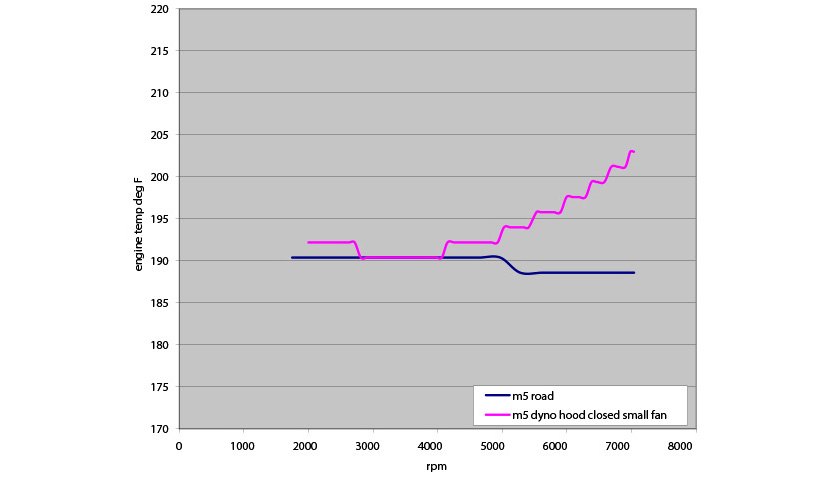
- Since the radiator cannot exchange heat on the dyno as efficiently as it did on the road, the engine block heats up significantly. Looking at the road temperature curve in Figure 6 – blue line, you can see that the engine block temperature stays between 191° F and 188° F. However the engine temperature measured during the dyno acceleration run with a standard type of fan starts at 192° F and ends at 203° F (Figure 6 – violet line). It should be noted that the coolant temperature gauge in the instrument cluster will hardly move in this case, even though the engine management system needs to correct for the increase, as 203° is not a high enough temperature to cause the vehicle to actually overheat.
Figure #6: Engine Block Temperature Comparison
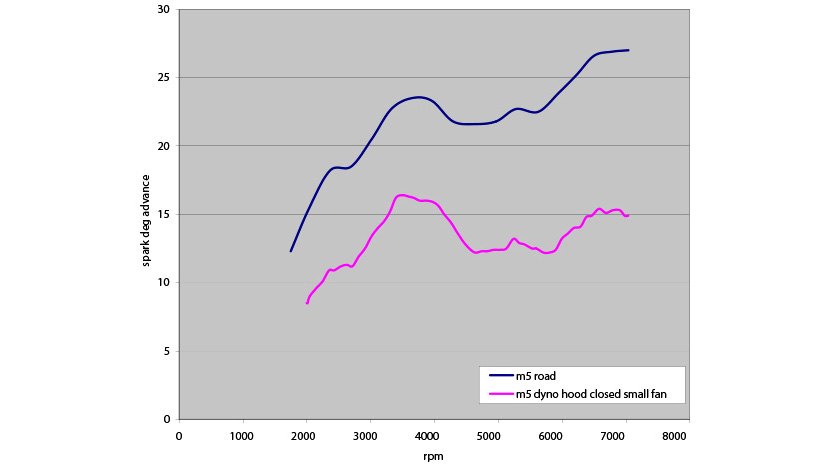
- The combination of the engine heating up and the air temperature sensor reading an artificially high value causes the engine management computer to go into the “engine savior mode”. The mixture is richened to an astounding 9.5 to 1 air fuel ratio (see Figure 7 – violet line); whereas the correct mixture measured on the road was 12.2, shown in Figure 7 – blue line. The ignition timing is retarded from a peak value on the road of 27° (see Figure 8 – blue line) down to 15° (Figure 8 – violet line). It is truly amazing how intelligent a modern BMW is. If you were to go back just 15 years, these same conditions would likely result in engine damage!
Figure #7: Fuel Mixture Comparison
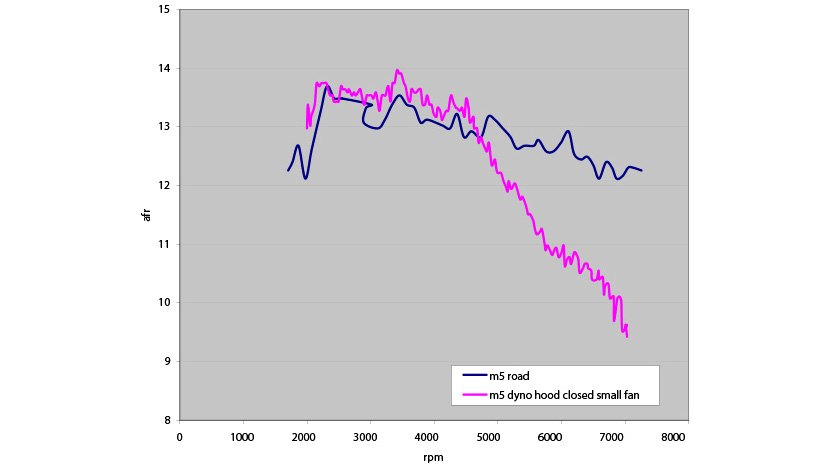
Figure #8: Ignition Timing Comparison
- Dinan will begin to eliminate these variables one by one so that you can see which aspects are the result of the intake air temp sensor and what portion is attributable to the engine running too warm.
- The next dyno run was performed with only one change: the hood was opened!
- As you can see in Figure 3B, with this simple change the power increased by approx 35 hp to 370 hp.
Figure #3B: E39 M5 Dyno Graph.
- The air intake sensor now absorbs a lot less heat from the engine (see Figure 9 – yellow line). With the hood open, the temperature reached 130° F, as compared to the 160° reading with the hood closed (see Figure 4). After the wide open run was completed, the temperature dropped to 120° F (Figure 9 – yellow line), compared to 148° F (Figure 9-blue line). However, this is still significantly warmer than the temperatures that were measured on the road.
Figure # 9: Intake Air Temperature Comparison- Hood open vs. closed
- Looking at the radiator temperature during the dyno acceleration run, using the standard dyno fan and the hood open, you can see in Figure 10 – yellow line, that the temperature is able to cool off more between runs. This enables us to start the run with a temperature of 155° F, ending at 205° F! Once again, this is still substantially warmer than the temperatures measured on the road (Figure 10-blue line)
Figure #10: Radiator Temperature Comparison
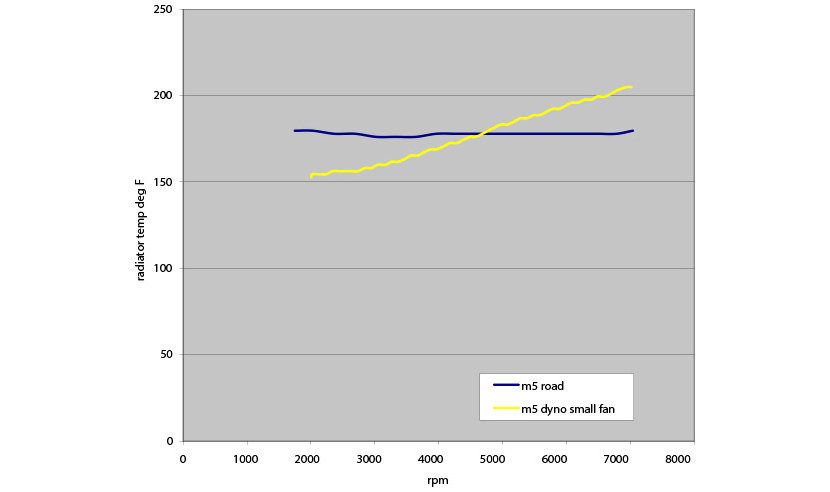
- Since the radiator still cannot exchange heat as efficiently as it did on the road, you can see in Figure 11 – yellow line, that the temperature starts at 182° F and ends at 197°, still warmer than the road test. (Figure 11- blue line)
Figure #11: Engine Block Temperature Comparison
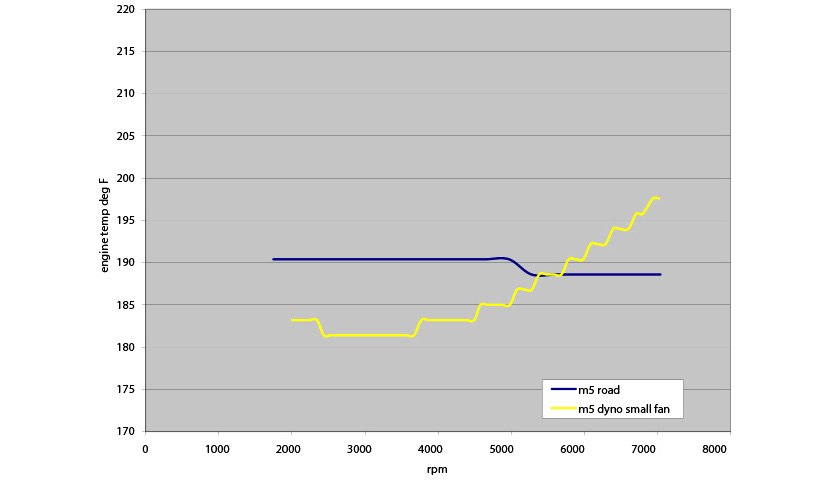
- While Dinan has made some serious progress here, and by now it should be obvious that you should never dyno a car with the hood closed, Dinan is still significantly short of duplicating the normal conditions the car would see on the road. The improvements Dinan has made thus far have leaned the air/fuel mixture from 9.5 to 1 (Figure 7-violet line) to 11.2 to 1 (see Figure 12 – yellow line); however compared to the correct road mixture of 12.2 to 1 (Figure 12 – blue line), the air/fuel mixture is still too rich. Ignition timing has also improved from 15° (Figure 8-violet line) down to 22° (Figure 13 – yellow line). This is still substantially less than the peak road value of 27° (Figure 13 – blue line) that would occur during actual road conditions. I believe that this is how most “power chips” are made, essentially leaning the mixture and advancing the ignition timing back to normal values. This will result in a measured power increase, however this gain is not real because it is merely compensation for the dyno environment.
Figure #12: Fuel Mixture Comparison
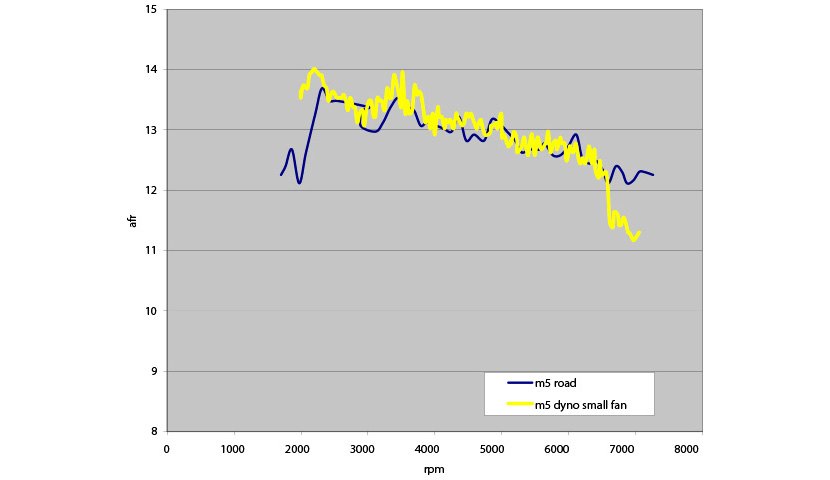
Figure #13: Ignition Timing Comparison
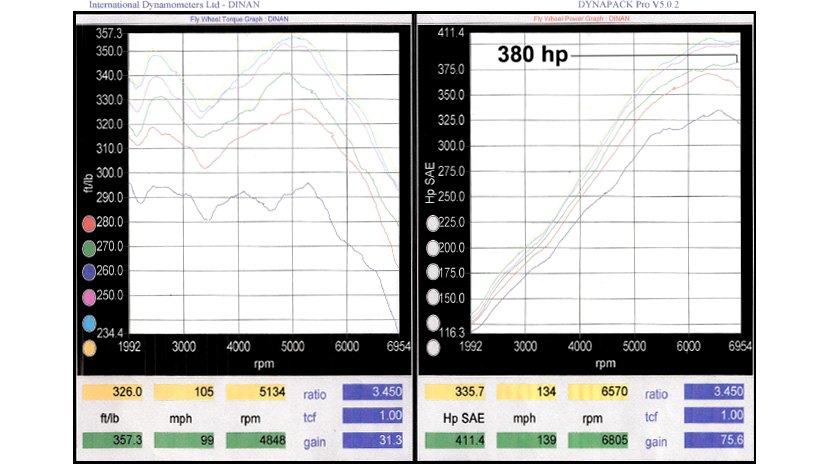
- The hood will remain open for all subsequent dyno runs. The next dyno run was performed with only one change: disconnection of the stock air temperature sensor and the installation of one at the air inlet. This is done in order to get the sensor to accurately reproduce the temperature of the air actually going into the engine. This will stabilize the engine tremendously and result in the computer making proper corrections for the conditions. As you can see in Figure 3C, the power increased by approx 10 hp, with the run producing 380 hp, with significantly less fall off at higher rpm.
Figure #3C: E39 M5 Dyno Graph
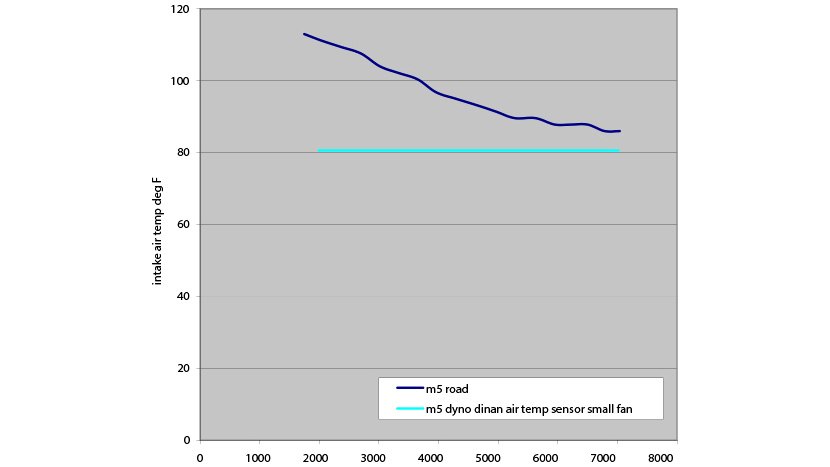
- The air intake sensor is now rock steady at 81° F (see Figure 14 – light blue line). This matches the actual ambient temperature in the room at this time and is more stable than the temperatures measured on the road (Figure 14 – dark blue line). This should help to explain why Dinan decided to move the intake air temperature sensor as part of Dinans Cold Air Intake System.
Figure #14: Intake Air Temperature Comparison
- The radiator and engine block temperatures remain the same as the previous run since Dinan is still employing the small fan.
- While Dinan has made even more progress, Dinan is still significantly short of the normal conditions the car would see on the road. The mixture has leaned out to an 11.7 to 1 air fuel ratio (see Figure 15 – light blue line) when compared to the 12.2 to 1 ratio measured on the road (Figure 15 – dark blue line). Ignition timing has been retarded from a peak value on the road of 27° (Figure 16 – dark blue line) down to 22° (Figure 16 – light blue line), but it is less stable. This is due to the cooler air intake sensor value causing the computer to lean out the fuel mixture and advance timing. Since the radiator still can’t exchange enough heat, the engine runs warmer than it normally would, causing the engine to detonate which in turn set off the knock sensor causing radical spikes (see Figure 16 – light blue line). The remaining richening and retarded ignition timing shown on these graphs are resulting from radiator and engine temperatures, not the engine intake air temperature reading since it has been stabilized.
Figure #15: Fuel Mixture Comparison
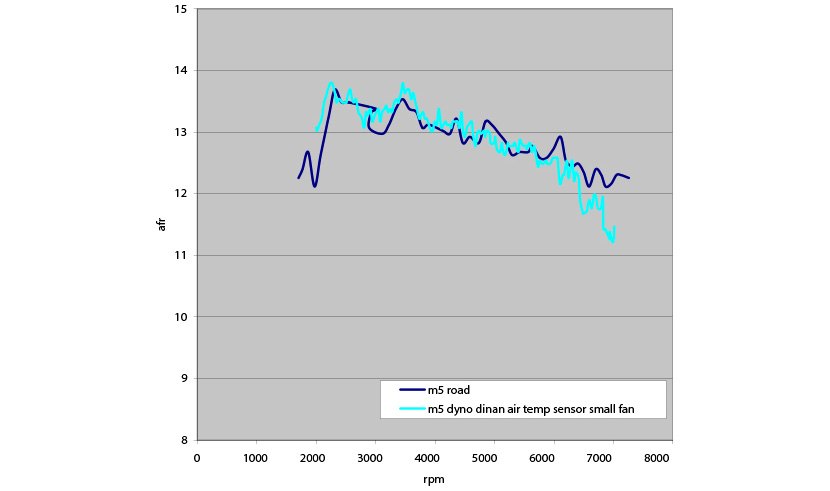
Figure #16: Ignition Timing Comparison
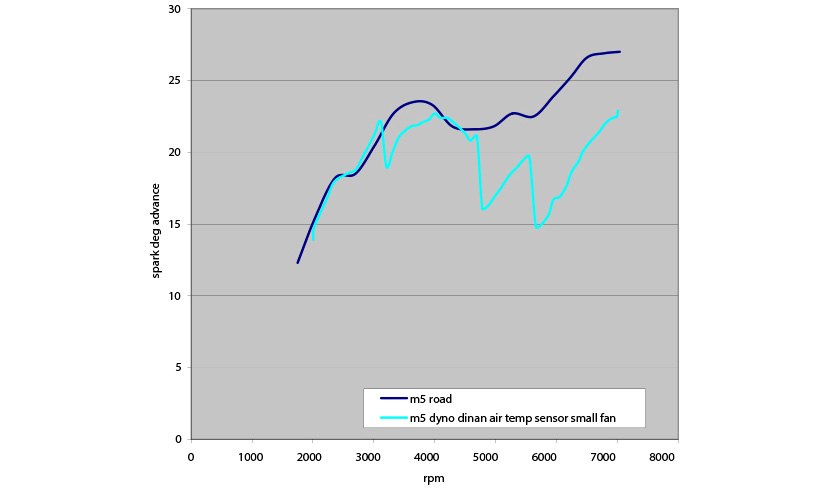
- The last step in Dinans attempt to reproduce actual road conditions is to employ a fan large enough to exchange enough heat that air temperatures at the end of the run exactly match the temperatures recorded on the road. The only change for this run was to replace the small fan with the Dinan® (Level 1) “Hurricane” fan.
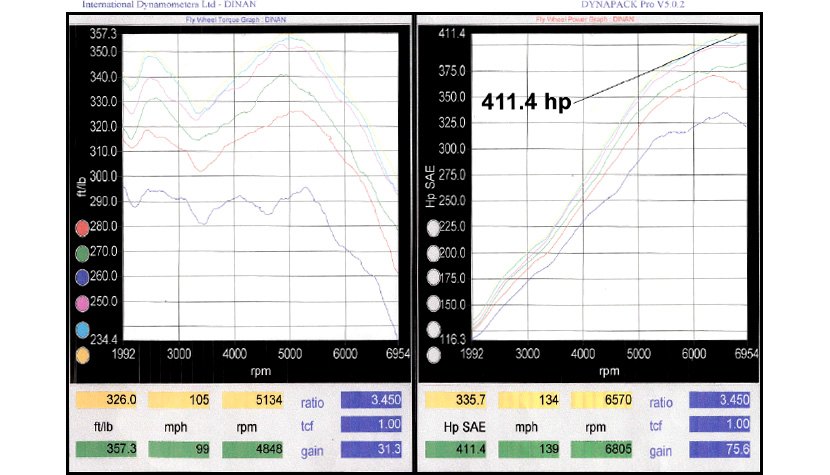
- As you can see in Figure 3D below (violet, blue and yellow lines), the power increased by approximately 30 hp to 411.4 hp, backed up by a 410 hp run. When the conditions are truly controlled you can usually produce runs with as little as 0.5 – 1.0% variance.
Figure #3D: E39 M5 Dyno Graphs
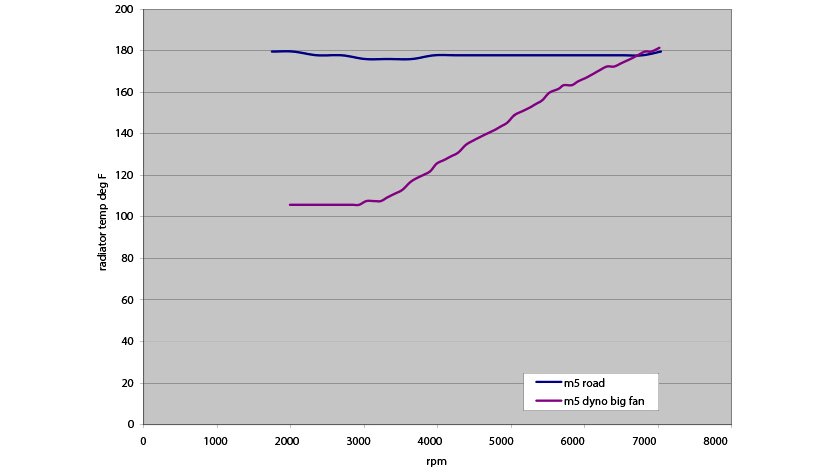
- The air intake temperature sensor was stabilized on the last run, so now let’s look at the radiator and block temperature graphs. As you can see, the radiator temperature during the dyno acceleration run (Figure 17 – violet line), using the very powerful fan and the hood open, allowed the temperature to cool off more between runs. This enabled us to start the run with a temp of 110° F and end at the exact same value as Dinan saw on the road, 175° F (Figure 17 – dark blue). Even with this huge fan, the largest I have seen on a chassis dyno, Dinan still must start at artificially low numbers so as not to exceed the road value by the end of the run! In other words, even Dinans huge 75-mph fan can’t duplicate the air flow the car would see on the road…but Dinan is getting closer!
Figure #17: Radiator Temperature Comparison
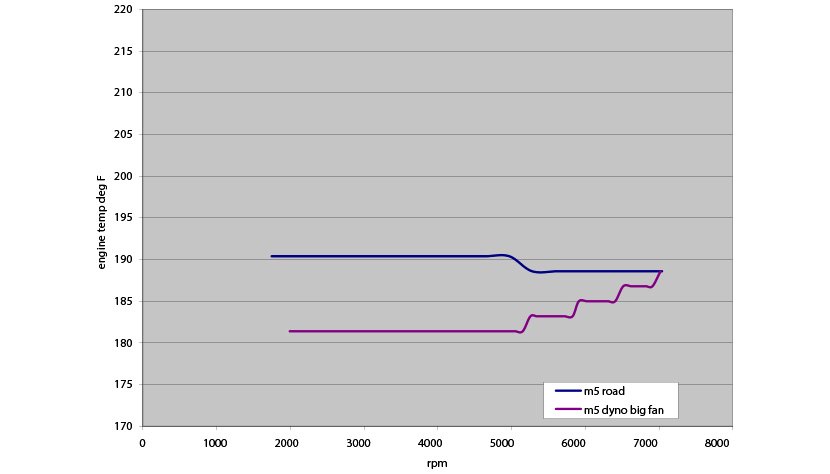
- Dinan is able to match the engine temperature recorded on the road at the end of the dyno run as well (Figure 18 – violet line). Figure 18 shows the engine temperature during the dyno acceleration run with the large fan. You can see that the temperature starts at 182° F and ends at 188° F equal to the road values (Figure 18 – blue line).
Figure #18: Block graph
- The air/fuel mixture and ignition timing now match the road numbers almost exactly (see Figures 19 and 20).
Figure #19: Fuel Mixture Comparison
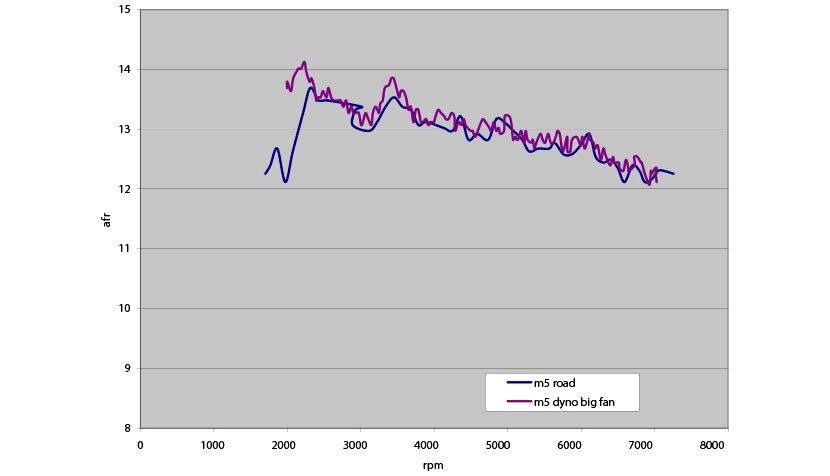
Figure #20: Ignition Timing Comparison
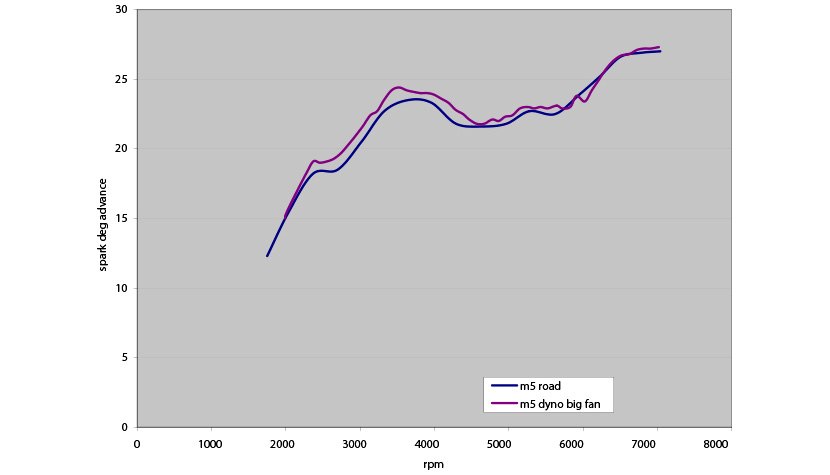
- The important thing here is to match the engine temperature as closely as possible. As Dinan has been able to achieve just a 7° variance (see Figure 18) from the beginning to the end of the run, with an ending value that is the same as the road number, the mixture and ignition timing match the road value. Now Dinan knows that they have real-world horsepower number. Remember that they have not added or changed any parts on the car during the course of this testing, with exception of the temperature sensor.
- Even still, Dinan falls short of duplicating actual road conditions in one area: they can’t reproduce ram air to the intake system. Dinan is currently developing a system that will produce enough ram air to get us even closer, but until it is completed Dinan will still measure less power on the dyno than the vehicle will actually make on the road!
Engine Wear
- Every engine will produce different power output, even if every variable is carefully controlled! This is due to production tolerances as well as maintenance and care during break-in. Most of the variances occur from cam timing errors and cylinder leak-down variances. Cylinder leak-down variances are the biggest variable. A desirable number for leak-down is less than 5%; however, it is very common to see numbers higher than that. It mostly depends on how the engine was broken in and, of course, maintained. The S2 M5 engine used in this test had an average leak-down just over 4%. The same engine had an average leak down of 3% one year ago. Comparing the previous dyno runs on this engine to more recent runs (see Figures 3E and 21), you can see a loss in power of approx 1%. This is the same car on the same dyno! However, due to normal wear, the power has dropped by 6 hp. You must realize that not every engine of the same type produces the same power. You also must realize that not every engine produces the same power throughout its life. BMW engines are very well manufactured with very consistent tolerances. Dinans dyno test show that almost all engines, without any defect, will be within a 5% window with the vast majority being within a 3% window.
Figure #21: Year old E39 M5 Dyno Graph
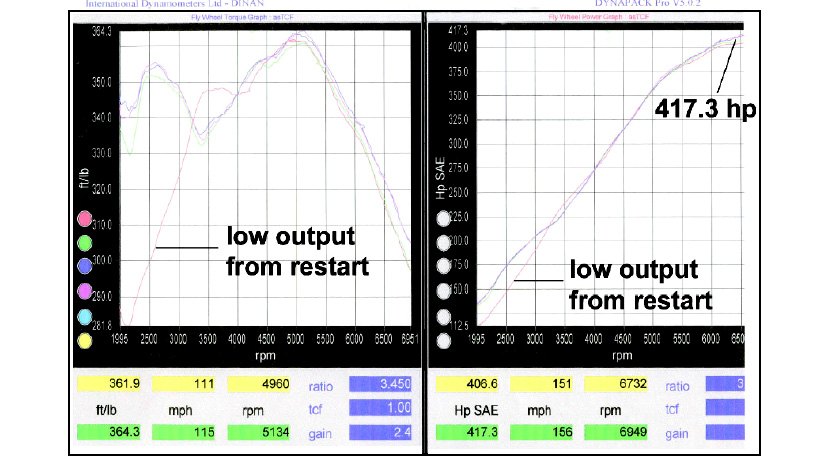
Figure #3E: Current E39 M5 Dyno Graph
Drivetrain Temperatures
- In addition to variances from the engine itself and the dyno environment, more variables come into play as a result of varying drive train oil temperatures. The graph above (Figure 21) depicts the recorded rear wheel horsepower for the S2-M5. As you can see, as the drive train oils heat up during the four dyno runs, the recorded horsepower increases from 406 to 417; an eleven horsepower gain resulting from nothing more than increased drive train oil temperatures! Remember that the engine was already warmed up to normal operating temperature before the four dyno runs were conducted. The temperatures of the air intake sensor, engine block and radiator were strictly controlled during these runs so that the only variables were drive train oil temperatures. The run that indicates the least output at low rpm was the first one after the engine was restarted (See notation- figure 21). The reason for this is that when the engine is first started, the camshaft and ignition timing have a different program to assist in warming up the catalyst for emissions purposes. As soon as the aft O2 sensor determines that the catalizer is operating, it automatically reverts to the normal program. The colder the catalytic converter, the more runs will produce reduced output. You can see that the oils have reached normal operating temperature for the last two runs as the measured output is very similar. Thermal couples can be used to further improve this accuracy. Many Winston Cup teams are now using chassis dyno’s to reduce drive-train friction. Since improvements in this area are so small in order for this work to be valid they must strictly control the drive train temperatures.
Data from a Stock E46 M3
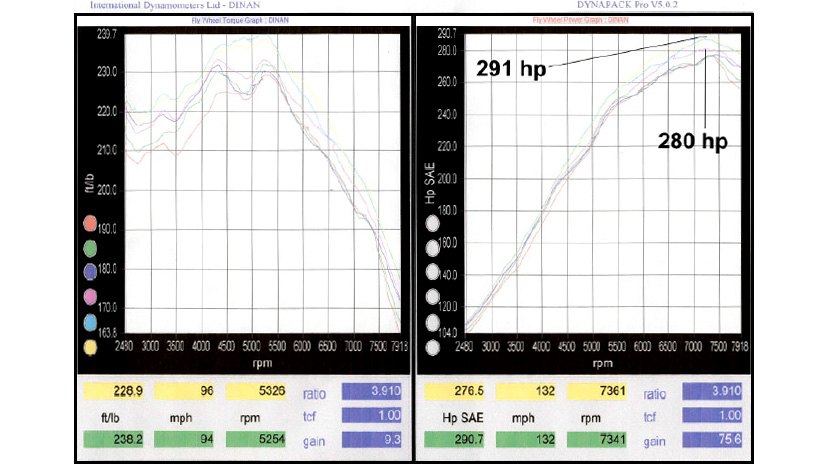
- The M5 engine is extremely sensitive to temperature control when dyno testing. Any increase in power results in an increase in heat and a corresponding increase in sensitivity. Not every engine demonstrates the same levels or types of sensitivities; some have cooling system sensitivities while others are sensitive to ram air volume and fuel octane. Each engine must be tested to determine what conditions exist on the road that do not exist on the dyno and what must be done to correct for them. Since the M5 started the testing with 93-octane fuel, I wanted to provide an example of how octane affects horsepower. The E46 M3 is an excellent example of an engine that is sensitive to octane. It has a very high volumetric efficiency as well as a very high static compression ratio of 11.5 – 1. The engine being tested was a stock M3 engine. It was first warmed up and stabilized using the method described previously for the M5, running 91-octane fuel. As you can see in Figure 22, where the engine was warmed up and the previously discussed testing procedures applied, the stock M3 produced 280 hp (Figure 22- violet line). Dinan then replaced the 91-octane fuel with 93 (available in most parts of the country). The M3?s computer was so quick to determine that the fuel had been improved that it only took four dyno runs for the timing to adapt to the increased octane and raise the power up to 291 hp (Figure 22 – light blue and yellow lines). A gain of 11 hp with just 2 points of octane. The M3 engine is equipped with a very good ram air system. While Dinans large fan is pushing large volumes of air into the ram air duct, the volume and velocity of air seen by the car on the dyno is still less than the engine would see on the road. The power output drops off after 7350 rpm because Dinan simply cannot duplicate the airflow the car would receive on the road in the dyno room, resulting in a loss of power. BMW claims peak power @ 7900 rpm. Dinan has no doubt that if Dinan could accurately reproduce the ram air that the M3 would receive on the road, Dinans peak power would move up from 7350 rpm to 7900 rpm. One of Dinans many engineering projects is to further enhance Dinans ram air capabilities in the dyno room.
Figure #22: E46 M3 Dyno Runs
Stock E46 M3 Ignition Timing Adaptations
- Figures #23 and #24 below are taken directly from the BMW factory diagnostic tool, demonstrating how ignition timing adapts to different fuel octane ratings. The same car is represented here, the only difference being the octane rating of the fuel. If you were to add 1° of ignition advance, the engine management system would detect it and retard the timing 1°. You can see that adding timing in the engine management software or “power chip” is futile because the computer will negate the change, as sufficient octane does not exist. However, you can see that adding higher octane fuel is like adding a “power chip” as the system adapts to the better fuel, making more power.
Figure #23: 91 Octane Knock Adaptations Diagnosis
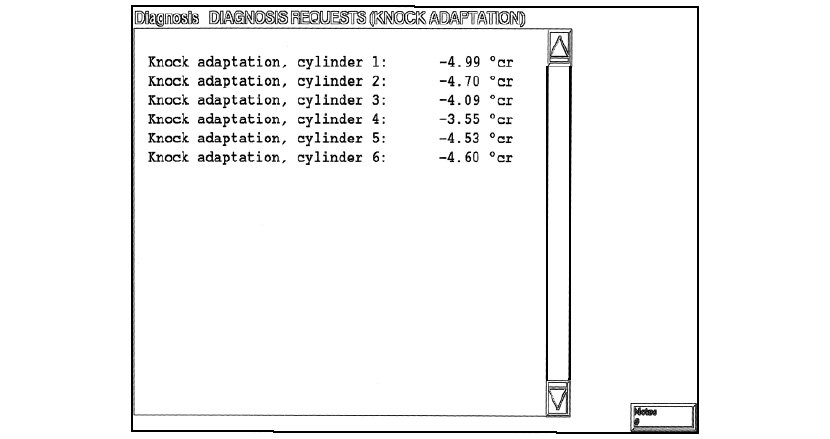
Figure #24: 93 Octane Knock Adaptations Diagnosis
Intercooled Forced Induction Systems
- Cars with intercooled forced induction systems (superchargers or turbo chargers) provide an even bigger challenge on the dyno. A separate fan must be employed in order to sufficiently cool the intercooler. Thermal couples must be installed in the inlet and outlet of the intercooler so that the temperature drop seen on the road can be measured. Once the temperature drop has been established, the fan speed must be adjusted until the same drop in temperature is maintained on the dyno as that was measured on the road. If the temperature drop cannot be achieved on the dyno, the error can be corrected for mathematically and the results will be very close.
Corrections
Once Dinan has determined the specific baseline procedure for a vehicle, the car is allowed to sit until early the following morning when the temperature is as close as possible to 77° F, the SAE standard. There are formulas for temperature, humidity and barometric pressure corrections from the SAE; however the correction tables are not completely accurate for a digitally controlled car. This is due to the corrections the car’s computer is making based on the conditions previously discussed. Dinan reduce this error further by performing all tests as close to 77° F as possible. An alternative would be to turn the corrections off in the software but this is a potentially dangerous approach. The most accurate results are obtained when the tests are performed in a climate-controlled dyno-room where temperature and humidity can be completely controlled for each test. By running Dinans tests as close to 77° F as possible, Dinan still must employ the SAE correction tables, but the amount of correction necessary is reduced and accuracy improved. Be aware that not all dynos correct for temperature, humidity and barometric pressure!
Conclusion
- If you decide to test your car on a dyno, whether in stock or modified form, be advised that you will not see the same results as BMW or Dinan. Putting the time consuming and tedious procedures aside, any number of things can cause your measurements to be different from those published. Even in a best case scenario, assuming that there is no need to be concerned about calibrations because the performance software has been supplied, it still takes the better part of three days to go through the proper testing procedure and collect the necessary data.
- If the engine is detonating or in the “savior mode” because of excessive temperatures, gains can not be measured. In fact if the car sits and heat soaks or cools for an excessive period of time between runs, enough variance can be created that the performance component enhanced car may show less power than the stock car, or even a very exaggerated gain.
- By way of summary, following are some of the more significant factors that you should keep in mind when considering dyno testing in general terms, as well as what to look for in the facility itself.
- Each dyno will produce different results (even with the same brand of dyno).
- The octane rating of fuel varies in different parts of the country (you must have a controlled fuel supply).
- Cold weather increases the gains and hot weather decreases them, even with temperature corrections.
- Lack of oxygen from exhaust in a dyno room will cause a loss in power.
- Slipping tires on the rollers will reduce the measured gains.
- Inertia type dynos have a lighter load than the car will see on the road. This is especially true for cars with heavy drive trains because some of the power will get absorbed spinning the masses faster. The inertia correction programs employed in these types of dyno’s are not completely accurate
- Fixed load dynos have a higher load than what the car sees on the road. This excessive load will result in a large mixture shift and the detonation sensor will be activated prematurely.
- No dyno can accurately simulate wind resistance, the ram air effect into the airbox or cooling of the intake tract under the hood.
- The size of the fan used during testing will change the power output.
- Oil temperatures will affect output due to changes in friction.
- The air intake temperature sensor will trigger adjustments to fuel mixture and ignition timing.
- Dinan® is certainly not the only BMW tuner in the world that understands the variables and complexity of proper dyno testing and tuning. I have a great deal of respect for the handful of BMW tuners around the world that share Dinans passion for accuracy. Unfortunately, this level of dyno testing sophistication appears to be the exception and simply won’t be found in common dyno facilities that rent their time. The purpose of this paper is to provide Dinans customers with a deeper understanding of test procedures and why they have been developed. Dinan too is constantly learning more about the science and updating Dinans equipment whenever significant improvements in the technology occur in an effort to provide Dinans customers with the most valid data possible. In addition, Dinan also employs an engine dyno test cell, but we’ll save a discussion on that technology for another time.
- THE FUTURE OF THE INTERNAL COMBUSTION ENGINE
-
THE FUTURE OF THE INTERNAL COMBUSTION ENGINE
By Steve Dinan
- Whether or not you believe in global warming or the world wide shortage of oil, one thing is certain: the price of fuel is going up, and governments all over the world are putting laws into effect to improve fuel economy and curb CO2 output.
- This will have profound effects on the cars Dinan loves to drive. The only way to make a high performance car engine that produces good power output on demand, low fuel consumption and CO2 output is to decrease the size of the engine and add turbocharging. The 335, 535, and 135 models are just the first few in a long line of cars BMW will likely produce. As Dinan moves forward it is likely that displacement will reduce, redlines will lower, and boost will increase. I am sure you all have heard of the new 4.4L Twin Turbo V8 coming out in the new X6. This engine will likely proliferate its way through the entire V8 product line over the next few years. Additional new engines will come out with a constant reduction of displacement and increased boost.
- To get the engines to make ever-increasing power output for their size, material strength will become more important. Once BMW has had a chance to evaluate the long term wear of the new 3.0l inline six, Dinan® believes BMW will upgrade the block and crankshaft rods and pistons inside the engine. They will likely increase boost as these upgrades are made, and as their confidence grows. Water jackets will be altered, and heat exchangers will get improvements to handle the extra load.
Great days ahead:
- With the introduction of turbos, Dinan can now make big power gains at low cost. The software has become incredibly complex, but even expensive software costs a lot less than making a whole turbo or supercharger kit. Dinan is going to be making a lot of really fast cars for relatively low cost.
Be careful:
- Turbos are like drugs. Every time you add boost the engine makes more power, and so you just want to keep adding more! The problem is that long-term durability can be compromised. Things that will not show up in the first few thousand miles, or even 10k or 20k miles, will eventually show up as the car gets old. So it’s prudent even for us serious enthusiasts to add boost carefully and let the long-term ramifications of Dinans decisions shake out before Dinan goes wild. In addition, as the factory upgrades the material strength of the engines themselves, Dinan will be able to increase boost even more. In other words, the next generation of the 3.0L inline six will safely produce a lot more power than the current one.
Pitfalls of small turbos:
- Turbos of old had a lot of lag. In an effort to reduce this, turbochargers have become very small and are now turning some incredible RPMs. It is very easy to exceed the rpm limit of the turbo, causing it to burst!! So before Dinan can make a lot of boost at high engine RPMs, it will be necessary to increase the size of the turbos. One side affect will be increased lag.
Computer controlled boost issues:
- With mechanically driven superchargers, like those in Dinans kits for the E36 and E46, any reduction of inlet restriction or improvement to intercooler pressure drop will cause the engine to see an immediate increase in boost and power. On the other hand, with a new computer controlled waste-gate on a turbocharged engine, like that of the 335i, modifications like cold air intakes or intercoolers with improved pressure drop hardly change power output! This is because the computer will lower the turbo RPM to compensate for reduced restriction, causing the engine to continue to see the programmed boost setting and almost the same power output. A small power gain will be realized as the turbo bypasses more exhaust gasses through the waste gate and less through the turbine. Additional power can be had from a gain in intercooler thermal efficiency, but not as much as one might expect. Dinans testing of intercoolers and cold air intakes has yielded much less power than people are advertising. Good news though, since these modifications reduce turbo RPM, Dinan can increase the boost at high rpm where it’s falling off, increase peak power output, and extend the rev band without over-reving the turbos.
- I hope you all enjoy the new direction at BMW. I know I will!
- SAFETY STRATEGIES FOR A BMW TURBO CONTROL SYSTEM
-
- Recent postings have suggested that Dinan® is backing off on power aggressively with Dinans 3.0L twin turbo software when the engine heat soaks. This is completely false.
- First off, temperature and safety correction logic in the software are actually written by BMW, not Dinan, and are in both the Dinan® and stock software. Dinan does not adjust the stock corrections or any other safety logic because Dinan deem such actions unnecessary and potentially unsafe for the engine. The software’s strategies are as follows…
- Ambient Air Temperature There is a standard correction for air inlet temperature for both fuel mixture and ignition timing. These are based on air density and are standard for all engine calibrations regardless of manufacturer or fuel injection brand. These corrections work the same on both naturally aspirated and forced induction engines.
- Basically, colder air is denser, which means there are more oxygen molecules going into the engine. Because of this, more fuel must be injected to maintain the proper air fuel ratio. The opposite occurs when the air is hot, in which case less fuel is injected into the engine.
- A colder charge is less prone to detonation, so the ignition timing is advanced with cold air and retarded with hot air to protect the engine.
- Overheat Protection There is also heat exchanger efficiency software that protects the engine if it gets hot. Laws of thermodynamics tell us that to exchange heat there must be a differential in temperature, and the greater the differential the more heat is exchanged. These corrections work the same on both naturally aspirated and forced induction engines.
- On a cold day when the radiator is working very well and is much colder than the block temperature, the ECU will lean out the mixture and advance the timing.
- On a hot day when the radiator gets closer to the engine block temperature and the block temperature rises because of radiator inefficiency, the software anticipates the engine overheating and retards the ignition timing so the engine loses power and thereby produces less heat. In addition, the fuel mixture is richened to absorb combustion chamber heat (fuel cooling). This fuel cooling also quenches the combustion chamber and reduces the tendency to detonate or ping.
- Detonation When the engine is detonating (pinging) due to poor fuel quality or excess cylinder pressure, the knock control system will retard the ignition timing so the engine loses power, reducing the tendency to detonate. In addition, the fuel mixture is richened to absorb combustion chamber heat (fuel cooling) and reduce the hot metal’s tendency to cause detonation.
- Catalyst protection When the engine’s duty cycle is high (high rpm, and especially at wide open throttle in high gear), there is less time for the catalyst to cool between cylinder firings. This puts more load or heat on the catalyst, so the fuel mixture is richened to quench the catalyst in order to keep it below the temperature where it will get damaged.
Some additional points:
- The Dyno Run verses the Road When you put your car on a chassis dyno it is impossible to get the same level of air flow that the car will experience on the road. It would require a fan the size of a wind tunnel. As cars get smarter, accurate dynamometer testing gets harder. While Dinan has the largest fan I have ever seen on a chassis dyno, it still will produce significantly less air flow than driving the car down the road. This will give you the triple whammy.
- Both the intercooler and the radiator will be less efficient, and as a result the engine will detonate more. So when repeated runs are made, the engine goes into save-itslife mode, aggressively reducing power by retarding the ignition timing and richening the fuel mixture as well as possibly lowering the boost depending on how extreme the condition is.
- If the piggy back boxes are not losing as much power as a stock or Dinan® car on the dyno, you should be afraid because this means that your engine is in jeopardy as a result of these safety controls being compromised. Maybe not on purpose, but none the less compromised.
- The same conditions are seldom seen on the road, so the correction while driving will not be as aggressive as you will see on the dyno. You can verify that this is true by the glowing reports of the cars performance on the road and the track. (JP posting and the video).
- Getting the most power As you can tell, these corrections are a good thing. Having said that, more power can be safely achieved by correcting the conditions that the ECU is correcting for.
- A better intercooler will reduce inlet temperature, advance the timing, and lean the mixture.
- A better oil cooler will reduce engine temperature, advance the timing, and lean the mixture.
- Higher octane fuel will reduce detonation, advance the timing, and lean the mixture.
- This is why Dinan require an intercooler and oil cooler for Dinans Stage 3 software, to protect your investment and extract the most power. Dinan also recommends using unleaded racing fuel whenever you do a track day.
- I hope this helps you to understand what is going on inside the incredible engine control system that BMW has put on your engine.
- SUSPENSION TRAVEL
-
By Steve Dinan
- Many newer BMWs provide very little suspension travel from the factory. In addition, many of the newer cars employ shorter progressive bump stops as compared to previous designs. A progressive bump stop is designed to absorb and dissipate energy when a wheel hits a large bump and a significant amount of the available wheel travel is used. As the bump stop is progressive, the initial contact is not felt by the driver. However, the bump stop is designed to gradually stiffen so that a large amount of energy can be absorbed without upsetting the car when it is on the limit of adhesion. If you go back many years, bump stops were simply crash barriers that prevented damage to the suspension system when all of the available travel was used up. Like so many automotive components, today’s bump stops feature more high-tech designs and are now a progressive spring of sorts that are actually part of the total spring rate. When properly designed, the current designs allow the cars to handle enormous bumps while maintaining adequate control.
- When lowering your car, it is important to properly “tune” the bump stops in order to maintain the appropriate amount of suspension travel. Clearly they must be made shorter as the lower ride height will reduce available travel. Many suspension companies will instruct you to simply cut the bump stops in order to shorten them. I highly recommend against this approach! As they are progressive, if you cut the soft end off of the bump stop you will most certainly feel the contact more because it is no longer as soft as it should be. If you cut off the stiff end, it will not be able to absorb enough energy over bigger bumps and the car will be too stiff, causing the car to bounce when the bump stop is fully compressed.
- As I mentioned before, BMWs are now designed with less suspension travel and shorter bump stops than ever before! This makes it more challenging to lower the cars without severely compromising handling capabilities, let alone ride quality.
- The new M3 and M6 are two examples of this situation. In stock form, the M3 has just 0.5 in. of suspension travel in the front before the progressive bump stop is contacted. In stock form the M6 has just 0.5 in. of travel front and rear. Both cars are equipped with very short bumps stops from BMW, making it difficult to make them any shorter and still be effective in terms of absorbing adequate amounts of energy. These models represent the most extreme examples of this issue Dinan has encountered to date!
- A significant part of any Dinan® suspension design is to thoroughly analyze suspension travel and bump stop requirements. The shortest bump stop that Dinan could employ needed to be 2.125 in. long in order to absorb an adequate amount of energy, making it only 0.25 in. shorter than stock! Since 0.5 in. of travel is the acceptable minimum to avoid premature bump stop contact, Dinan had to actually increase travel if Dinan wanted to lower the cars at all. In addition, all of the M6 models and most of the M3s are equipped with EDC (electronic damping control). The damping characteristics of the stock EDC shocks are very good, so Dinans objectives included making the lowered cars function with the factory electronic shocks.
- In addition, the M3s not equipped with EDC also feature a great stock shock. They are lightweight and offer excellent damping characteristics, necessitating the same considerations as with the M6 and EDC equipped M3s.
- The Dinan® solution was to increase travel in the spring perch area, without requiring replacement of either type of stock shock. This was accomplished in the front of the M3 and M6 by modifying the stock upper guide support (Or spring perch) and fabricating completely new upper spring perches in the rear of the M6!
- For the M3, Dinan was able to shorten the front guide support by 0.3 in. so that when combined with the shorter bump stops a total of 0.55 in. of travel is achieved. This enabled us to lower the M3 by 0.5 in. while retaining the appropriate amount of travel for improved handling and civilized ride quality.
- For the M6, the spring perches were shortened by 0.5 in. in the front and 0.85 in. in the rear, so when combined with a shorter bump stop travel is increased to 0.75 in. up front and 1.1 in. in the rear. This enabled us to lower the car by 0.75 in. front and rear while retaining the appropriate amount of suspension travel. Everyone, including Dinan, would like to lower the M3 and M6 even more, but Dinan will not compromise the performance and ride quality purely for the sake of aesthetics.
- The custom spring perches and bump stops certainly add some cost to the spring set/suspension system but are well worth the investment when you consider the dramatic improvements in handling and maintaining civilized ride quality. Recent features appearing in Modified Luxury and Exotics, Bimmer and many more to come will attest to the benefits of a properly tuned suspension system.
Performance without sacrifice
- FUEL GUIDE
-
- When switching from a lower octane fuel to a higher octane fuel, special care must be taken to ensure the safety of the motor. This is most critical when switching from a lower octane to Ethanol or Race Fuel. Running Ethanol and Race Fuel maps with lower quality fuel can and will destroy your spark plugs and potentially your engine. Please follow these instructions when switching fuel:
- Drain the gas tank of all fuel.
- Let the engine idle and stall out.
- Fill the tank with the higher octane fuel.
- Drive for 15 miles, lightly. Lower octane fuel may still be in the fuel lines, especially on dual injection vehicles. If switching to Ethanol, you may get a fault for fuel trims out of range. When this occurs, clear the fault code, switch to the ethanol map, and continue driving lightly.
- Switch to the higher octane map and drive lightly for 5 miles before going wide open throttle.
- If you detect any hesitation, timing pull, audible knock, or other indications something is not right, let off the throttle immediately. You may still have lower quality fuel in the lines. Repeat the steps above.
OCTANES & PROGRAMS
- Never use a octane lower than whats prescribed by the tune. For example, do not use 91 Octane with a 93 Octane tune. You may use a higher octane than prescribed by the tune. For example, running 93 Octane on a 91 Octane program is fine, and in some cases may offer a bump in performance.
RACE FUEL INFO
- Dinan only recommends using Sunoco GT260 for 100 Octane tunes and Sunoco GT260+ for 104 Octane tunes. Unless specified otherwise, only use types of fuels as other fuels may not be compatible.
ETHANOL INFO
- Ethanol content varies dramatically. A pump labeled for E85 may have content from 85% all the way down to 51% depending on the location and season in the USA. This can vary outside the USA as well depending on ethanol laws. Most non-flex fuel E85 max only have an operating range of E60-E85. Always confirm the operating rage on their product pages or by contacting Dinan. Do not use ethanol content lower or higher than specified for the map. If Ethanol content is too low, the engine may knock, and you may experience fuel trim issues. If the Ethanol content is too high, you may experience fuel trim issues, and you may tax the fueling system, causing lean conditions. Please note, Dinans tunes for regular gasoline are not designed for ethanol. However, ethanol is commonly found at the pump mixed with gasoline. So long as the fuel trims are not maxed, and the fueling system is not maxed out, this is typically ok unless specified otherwise.
OCTANE BOOSTER
- Do not use octane booster. It may do nothing at all, or it may cause other problems.
LEADED FUEL
- Do not use leaded fuel. It will destroy your oxygen sensors.
WATER / METHANOL
- Water / Methanol may have adverse effects, and potentially disastrous effects when used on higher octane maps with lower octane fuel. Usage is up to the end users discretion.
NITROUS OXIDE
- Nitrous Oxide may have adverse effects, and potentially disastrous effects. Usage is up to the end users discretion.
ACCIDENTAL LOW QUALITY FUEL
- If you accidentally use lower quality fuel than prescribed by the tune, draining the tank is recommended. In the case where youre running a higher pump fuel program, such as 93 Octane, and only 91 Octane is available, you can continue driving so long as you take extra precaution. Do not drive the car hard. If the engine is boosted, stay out of boost. Keep IAT low. Dont lug out the engine, and only use light throttle input. Essentially, be careful. If you detect knock, dont continue driving.
ROUGH AKI to RON CONVERSION GUIDE
- This guide is for a rough estimate only. Many factors will contribute:
- 87 AKI = 91 RON
- 91 AKI = 93 RON
- 93 AKI = 98 RON
- 100 AKI = 104 RON
- 104 AKI = 108 RON
TERMINOLOGY
- E in E85 stand for Ethanol, and 85% stands for the percentage of Ethanol in the fuel. North American Region (NAR) uses the Anti-Knock Index (AKI), (RON+MON)/2, or (R+M)/2 when describing octane. In the Rest of the World (ROW), RON is used when describing octane. RON is the Research Octane Number and MON is the Motor Octane Number.